

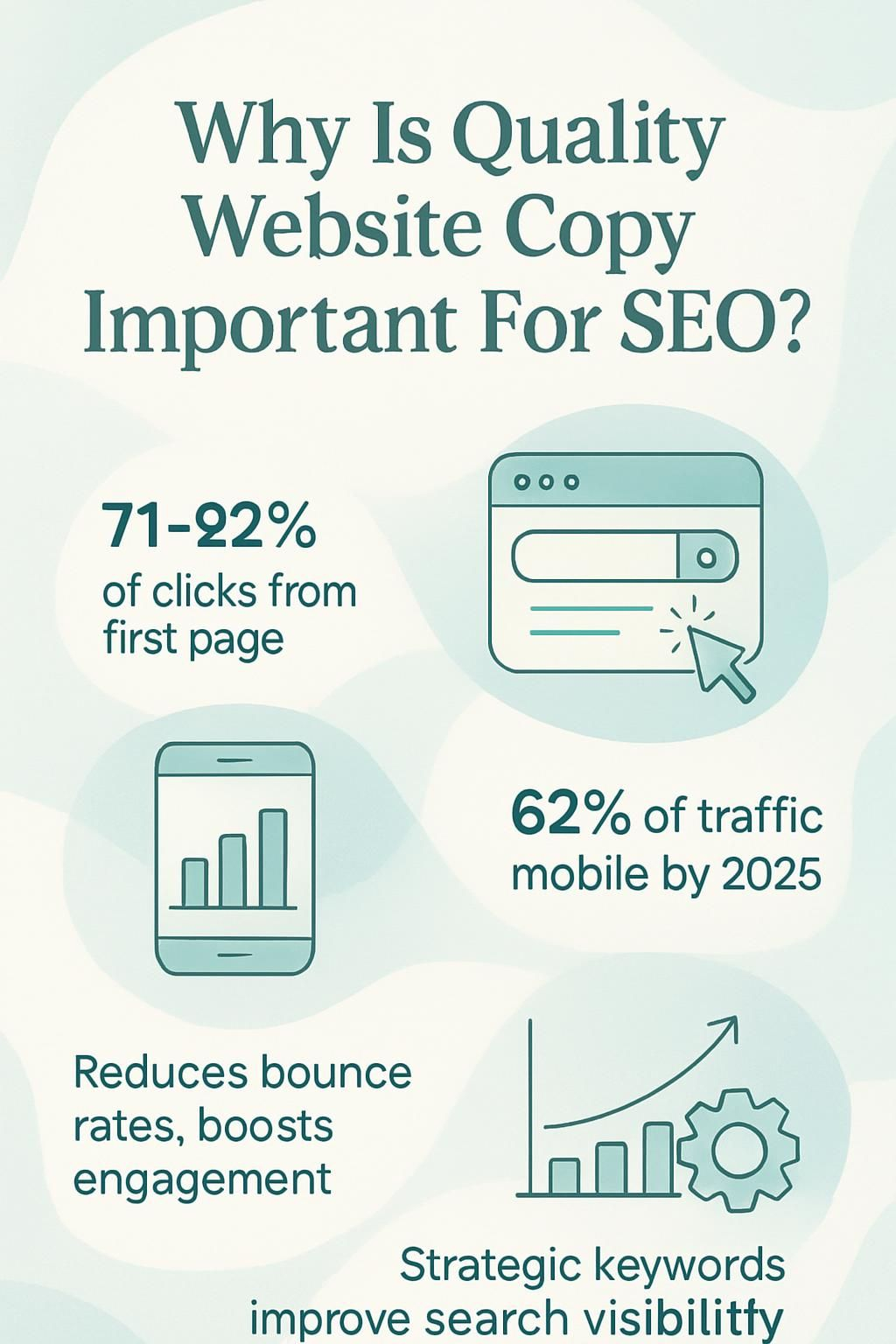
Quality website copy means creating content that serves both readers and search engines effectively. Over 1 billion websites compete for Google’s first page, with first-page results capturing 71 to 92 percent of click-throughs.
This fierce competition makes exceptional web content absolutely critical for business success online.
The importance of quality website copy extends far beyond simple text on a page. Google prioritises relevant, valuable content that meets user needs, making well-crafted copy the foundation of effective SEO strategy.
High-quality content contributes to improved search engine rankings, organic traffic growth, and higher conversion rates across all industries.
Key trends in website copywriting include the rise of mobile-first indexing, with 62 percent of global web traffic expected to come from mobile devices by 2025. Google’s focus on Expertise, Authoritativeness, and Trustworthiness (E-E-A-T) has transformed how search engines evaluate content quality.
Consistently publishing long-form content over 1,000 words drives backlinks and establishes authority within specific niches.
Companies across Australia demonstrate diverse approaches to implementing SEO-friendly copy strategies. Some focus heavily on keyword optimisation, while others prioritise user experience and readability.
My experience founding Jeff Lee Copywriting in 2010 has shown me that businesses combining both approaches achieve the strongest results.
The shift towards quality-focused content has broader implications for digital marketing, user engagement, and brand building online. Engaging copy that uses proper heading formats and logical structure reduces bounce rates significantly.
Regular content updates and avoiding keyword stuffing have become necessary practices for sustained SEO performance.
Quality website copy transforms your online presence completely.
Key Takeaways
- Quality website copy directly improves search engine rankings by providing valuable, engaging content that Google’s algorithms reward with higher visibility.
- First-page search results capture 71-92% of all click-throughs, making quality copy essential for competing among over 1 billion websites.
- Well-written content reduces bounce rates and increases user engagement, sending positive signals to search engines about your site’s value.
- Strategic keyword integration and scannable formatting help search engines understand content while maintaining natural readability for human visitors.
- Mobile-friendly content is critical since 62% of global website traffic will come from mobile devices by 2025.
What does quality website copy mean?
Quality website copy is text that speaks directly to your target audience and drives them to take specific actions. Think of it as your digital salesperson working around the clock.
After founding Jeff Lee Copywriting in 2010, I’ve seen countless businesses transform their online presence through strategic copy that addresses customer pain points head-on. This isn’t just pretty words on a page; it’s persuasive writing that demonstrates exactly how your business solves problems.
Copy directly prompts action; content is informative/educational.
Effective website copy requires extensive research, careful editing, and multiple rewrites. Most business owners skip these crucial steps, which shows in their conversion rates. Quality copy aligns perfectly with your website’s purpose, whether that’s building brand awareness, generating leads, or driving sales.
It maintains consistency across all platforms to establish strong brand messaging and reflects your core values. Visitors make decisions within seconds of landing on your site, making high-quality copy absolutely essential for user experience and audience engagement.
How does quality website copy affect SEO?
Quality website copy acts as the backbone of your SEO strategy, directly influencing how search engines perceive and rank your site. Your content quality determines whether visitors stay engaged or click away within seconds, making it a critical factor in your digital marketing success.
How does it improve search engine rankings?
Google’s algorithm ranks pages based on informative, engaging content that builds confidence. Search engines reward websites that consistently deliver value to users. My 13 years of experience in Marketing and Communications has shown me that content quality, keyword optimisation, and backlinks have a significant influence on SEO.
Search engines crawl your site looking for signals that indicate expertise and relevance.
High-quality, consistent copy enhances rankings and ensures proper Google indexing. Search engines favour websites that publish valuable information regularly. Well-executed content strategy is vital for improved rankings across all major search platforms.
The relative positioning of the content and its quality are crucial for rankings in competitive markets. Fresh, informative content tells search engines your website stays active and current.
Low-value content can harm SEO rankings significantly. Search engines penalise sites that offer little substance to visitors. Consistent content publishing is important for SEO; sporadic posting reduces visibility and signals inactivity to crawlers.
High rated content results in high quality search engine optimisation that drives long-term success. Strategic keyword placement within valuable content creates the perfect recipe for climbing search results.
How does it enhance user experience?
Search rankings matter, but user experience drives real results. Quality website copy transforms how visitors interact with your site, creating connections that keep them engaged and coming back for more.
Well-written content provides relevant answers to search queries, promoting longer site visits and reducing bounce rates. Engaging storytelling and clear information architecture guide users through your site naturally.
Diverse content formats like videos and infographics cater to various audience preferences, making your message accessible to different learning styles. Accessible content with accurate image descriptions creates an inclusive environment that welcomes all visitors.
This balanced content strategy fosters trust and establishes brand authority, turning casual browsers into loyal customers who value your expertise.
How can it increase organic traffic?
Quality website copy acts like a magnet for organic search visitors. Google’s algorithms favour content that answers user questions directly and provides real value. Fresh, relevant content signals to search engines that your site deserves higher rankings.
Higher rankings mean more visibility in search results, which translates to more clicks from potential customers.
Well-crafted web content creates a snowball effect for organic traffic growth. Visitors spend more time reading engaging copy, which reduces bounce rates and improves your site’s authority signals.
Content marketing through valuable articles and pages encourages other websites to link back to yours. These backlinks boost your website authority and credibility, creating a powerful cycle that drives even more organic search traffic over time.
High-quality SEO content that satisfies users’ needs is more likely to rank highly in search results and drive organic traffic.
How does it build brand authority and trust?
Increased organic traffic naturally leads to greater brand visibility, which sets the foundation for building credibility with your audience. Google’s E-E-A-T framework (Experience, Expertise, Authoritativeness, Trustworthiness) plays a crucial role in how search engines evaluate content.
Well-researched copy backed by reliable sources demonstrates expertise in your field. Visitors recognise authentic information when they see it. This recognition transforms casual browsers into loyal customers who trust your brand.
Consistent production of high-quality content signals to both users and search engines that your business stays active and engaged. Accurate, well-cited content enhances your website’s credibility significantly.
From my experience managing websites, I’ve noticed that authoritative, in-depth, original content achieves better rankings and drives more traffic. Engaging content fosters deeper connections with your audience.
These connections build lasting trust that competitors struggle to replicate.
Domain authority grows stronger when your content marketing strategy focuses on information authenticity. E-E-A-T isn’t a direct ranking factor, but it’s vital for Google’s content quality assessment.
Search visibility improves when visitors spend more time reading your content and sharing it with others. User engagement metrics reflect the trustworthiness of your brand. Strong engagement metrics tell search engines that people value what you offer, creating a positive cycle that boosts your overall online presence.
Key elements of high-quality website copy
Creating high-quality website copy isn’t just about pretty words on a page. I’ve learned that effective content combines strategic elements that work together like pieces of a puzzle to boost your search engine rankings and connect with your audience.
What makes messaging clear and concise?
Clear messaging starts with a compelling headline that grabs attention instantly. I focus on concise body text that delivers value without wasting words. Strong call-to-action elements guide visitors toward the next step.
These three components work together to create powerful first impressions and boost conversions.
Simple language enhances readability and prevents overwhelming visitors with complex jargon. Action-oriented language provides clarity while creating urgency for better engagement.
Short, varied sentences improve user experience and help search engines understand content better. Visual design elements support the messaging by strengthening emotional connections with the audience through strategic optimisation and continuous testing.
How do you choose and use targeted keywords?
Clear messaging sets the foundation, but targeted keywords give your content direction and purpose.
I start with thorough keyword research to understand what my audience actually searches for online. Tools like Google Keyword Planner reveal search volumes and competition levels for different terms.
Long-tail keywords work particularly well because they target specific search queries that match user intent. For example, “best coffee shops Melbourne CBD” attracts more qualified visitors than just “coffee shops.”.
Audience analysis plays a crucial role in keyword selection. I examine trending topics on social media platforms to discover what resonates with my target market right now. These insights help me incorporate fresh, relevant terms that boost online visibility.
Once I’ve identified the right keywords, I weave them naturally into headings, meta descriptions, and body content. The key is making them feel organic rather than forced, which improves both search engine rankings and user experience.
Why is logical structure and readability important?
Choosing the right keywords sets the foundation, but content structure determines how well those keywords perform. Logical structure and readability work hand in hand to create content that both search engines and users love.
Poor structure kills engagement faster than you can say “bounce rate.”.
Search engines assess user experience metrics that directly impact rankings. Google favours accessible, well-organised content because it signals quality to both algorithms and readers.
Proper heading formatting from H1 to H6 helps search engines understand content hierarchy while making pages easier to scan. Screen readers rely on these headings to help visually impaired users navigate content smoothly.
This accessibility factor has become a crucial ranking signal that many website owners overlook.
Readability scores directly influence conversion rates and engagement metrics. Well-structured content with logical flow reduces bounce rates, which sends positive signals to search engines about content quality.
Users spend more time on pages that present information clearly through short paragraphs, bullet points, and scannable text. Modern search engines reward this user-focused approach because engaged visitors indicate valuable content that deserves higher rankings.
How do compelling calls-to-action work?
Compelling calls-to-action work like magnets that pull visitors towards your desired outcome. I’ve seen how strategic placement makes all the difference, with 90% of readers noticing CTAs that accompany headlines.
Effective CTAs grab attention through contrasting colours and persuasive visual cues that create a clear visual hierarchy on your page. Action-oriented language creates urgency and drives immediate response.
Clear, concise messaging tells visitors exactly what to do next.
Strategic positioning transforms visitor behaviour dramatically. CTAs perform best above the fold or at content’s end, where readers naturally pause to make decisions. Mobile optimisation is crucial as more users browse on smartphones and tablets.
A/B testing multiple variations helps refine messaging and design elements for maximum conversion rates. Different marketing channels require specific approaches to drive purchases, sign-ups, or enquiries effectively.
Smart CTA design combines psychology with practical functionality. Persuasion techniques work best alongside user-friendly layouts that guide the eye naturally. Lead generation improves significantly through well-crafted calls-to-action that speak directly to visitor needs.
Testing various button colours, text sizes, and placement options reveals what resonates with your specific audience. The right CTA transforms passive browsers into active participants in your business goals.
Best practices for writing SEO-friendly copy
Mastering SEO-friendly copywriting requires balancing search engine requirements with genuine human connection – and I’ll show you exactly how to strike that perfect balance.
Why write for users first and search engines second?
I focus on my readers because Google rewards content that genuinely engages humans. Search engines have become incredibly smart at detecting when content serves users versus when it simply chases algorithms.
Writing for users first creates natural engagement patterns that search engines love. People spend more time reading, share content more often, and return to sites that speak their language.
User-focused content builds the foundation for lasting SEO success. Satisfied visitors create backlinks organically, boost conversion rates, and generate repeat traffic that strengthens site authority over time.
Content that meets real audience needs fosters loyalty and trust, which translates into better search engine rankings. Google’s algorithms prioritise websites where users find genuine value, not just keyword-stuffed pages.
Natural integration of key phrases maintains readability while avoiding search engine penalties that hurt long-term performance.
How to naturally incorporate keywords?
Natural keyword integration transforms your content from robotic text into engaging copy that both users and search engines love. I’ve discovered that forcing keywords creates awkward sentences that drive visitors away faster than a spider in the shower.
- Place primary keywords in your page title and first paragraph to signal relevance to search engines without making it sound forced or unnatural.
- Sprinkle related terms throughout your content instead of repeating the same keyword phrase multiple times, which helps avoid keyword stuffing penalties.
- Use keywords in your headings and subheadings where they fit naturally, creating a logical flow that guides readers through your content.
- Write your content first, then review where keywords can fit smoothly without disrupting the natural reading experience or changing your intended meaning.
- Include keywords in your meta descriptions and title tags, but focus on creating compelling copy that encourages clicks from search results.
- Replace generic words with keyword variations that maintain the same meaning while boosting your content’s topical relevance and search visibility.
- Ask yourself if each keyword placement sounds natural when read aloud, as awkward phrasing signals poor quality to both users and algorithms.
- Distribute keywords evenly across your content rather than cramming them into the opening paragraphs, creating better keyword density throughout the page.
- Use synonyms and related phrases that support your main keywords, giving search engines more context about your content’s true purpose.
- Focus on answering user questions naturally, as this approach automatically incorporates relevant keywords while providing genuine value to your audience.
How does scannable text and headings help?
After mastering natural keyword integration, the next step focuses on making content easy to scan and digest. Scannable text and headings transform dense blocks of text into digestible chunks that readers can quickly navigate.
This approach dramatically improves user experience and keeps visitors engaged longer on your website.
Proper heading structure using H1 to H6 tags creates a clear information hierarchy that search engines love. Short paragraphs with a maximum of four sentences make content less intimidating to read.
Bullet points, subheadings, and varied sentence lengths help break up text naturally. Screen readers can navigate content more easily with well-structured headings, making your site accessible to visually impaired users.
Search engines reward websites that keep users engaged, and scannable formatting directly impacts these engagement metrics. Clear headings help visitors locate specific information quickly without scrolling endlessly through walls of text.
This improved navigation experience reduces bounce rates and increases time spent on your pages, sending positive signals to search algorithms about your content quality.
Why include relevant internal and external links?
Links act like bridges connecting different parts of your website and the broader internet. I’ve discovered that internal links help search engines understand website structure while guiding visitors through related content on your site.
These connections keep users engaged longer and boost your engagement metrics significantly.
External links to credible sources establish your site authority and show search engines you’re connected to quality information. Smart link management through tools like Google Search Console helps optimise your linking strategies for better SEO outcomes.
Both dofollow and nofollow links serve different purposes, with dofollow links passing SEO value while nofollow links still drive valuable referral traffic. Strategic linking expands your audience reach and creates opportunities for reciprocal traffic from other websites.
Mobile-friendly content becomes even more powerful with well-placed links that enhance user navigation across all devices.
Common mistakes to avoid in website copy
Even seasoned website owners fall into traps that sabotage their SEO efforts without realising it. I’ve seen brilliant businesses shoot themselves in the foot with these avoidable blunders.
What is keyword stuffing and why avoid it?
Keyword stuffing represents the excessive use of specific keywords to manipulate search engine rankings. This blackhat technique involves cramming target phrases unnaturally throughout content.
I’ve witnessed many website owners fall into this trap, thinking more keywords equal better rankings. Google’s Panda Update changed the game completely. Search engines now penalise sites that engage in these spam policies.
Two types exist: visible stuffing that users can see, and hidden stuffing that remains invisible to visitors but detectable by search engines.
Content readability suffers dramatically when keyword density becomes excessive. User experience takes a massive hit. Bounce rates skyrocket as visitors quickly leave poorly written pages.
I’ve seen websites lose their search engine rankings overnight due to these unethical SEO practices. The penalties can be severe, including complete exclusion from search results. Modern algorithms prioritise natural, helpful content over keyword-heavy text that serves no real purpose.
Effective SEO practices focus on creating valuable content for real people. Smart keyword distribution feels natural and enhances the reading experience. Content clarity should never be sacrificed for search engine manipulation.
I always recommend writing for humans first, then optimising for search engines second. This approach builds genuine authority and trust with both visitors and search algorithms.
Why is mobile-friendly content essential?
Mobile-friendly content has become absolutely critical for website success. Google uses mobile-first indexing, which means search engines prioritise mobile versions of websites for search results.
This shift makes responsive design the best practice for mobile websites, facilitating easier maintenance and improved user experience. Statistics show that 62% of global website traffic will come from mobile devices by 2025, making mobile optimisation impossible to ignore.
Poor mobile content creates serious problems for website performance. The average bounce rate for mobile reaches 52.1%, meaning over half of mobile visitors leave websites without interacting.
Common mistakes affecting mobile readability include lengthy paragraphs and intrusive pop-ups that obstruct main content. These issues directly impact search engine optimisation rankings and user satisfaction.
Mobile users demand quick, accessible content that works seamlessly on their devices. Pop-ups should remain minimal with clear exit options to avoid frustrating visitors. Content readability becomes even more important on smaller screens where users scan information rapidly.
Effective call-to-action buttons must be designed specifically for touch navigation to convert mobile traffic successfully. Understanding common mistakes helps website owners avoid these costly errors.
How often should you update and refresh content?
Mobile-friendly content sets the foundation, but fresh content keeps your website alive and relevant. Content refresh becomes your secret weapon for maintaining strong search engine rankings and audience engagement.
Daily updates work best for news sites and active blogs that thrive on current events. Weekly updates suit businesses with frequent product changes or service offerings. Monthly updates prove adequate for industries where information changes slowly, particularly when focusing on evergreen content.
Seasonal updates become necessary for businesses that shift products based on holidays or special events. Event-driven updates help you leverage industry happenings or company milestones for timely, relevant material.
Performance analytics reveal which pages need immediate attention, while refreshing website copy every 6 to 12 months keeps your digital marketing strategy sharp and aligned with business goals.
Conclusion
Quality website copy serves as your digital storefront’s best salesperson, working around the clock to attract visitors and convert them into customers. Excellent content doesn’t just satisfy search engine requirements; it builds genuine connections with real people who need your products or services.
Your words become the bridge between what customers want and what you offer. Effective copywriting transforms casual browsers into loyal customers while boosting your search rankings naturally.
Content that serves people well will always serve your business better in the long run.
FAQs
1. How does quality website copy boost your search rankings?
Search engines love fresh, relevant content that answers what people are actually searching for. Quality copy acts like a magnet for both Google’s crawlers and your target audience. When your content hits the sweet spot between readability and keyword relevance, you’ll climb those search results faster than a cat up a curtain.
2. What makes website copy “quality” for SEO purposes?
Quality copy speaks directly to your readers while naturally including the terms they search for. It flows like a good conversation, not a robot’s manual. Your content should solve problems, answer questions, and keep visitors glued to your page longer than they planned.
3. Can poor website copy actually hurt your SEO efforts?
Absolutely, mate! Thin, repetitive, or keyword-stuffed content sends visitors running for the hills. Search engines notice when people bounce off your site quicker than a kangaroo on hot pavement. Poor copy damages your credibility and tanks your rankings faster than you can say “algorithm update.”
4. How often should you update your website copy for SEO?
Regular updates keep your content fresh and relevant in Google’s eyes. Aim to refresh your main pages every few months and add new content weekly if possible. Think of it like tending a garden; consistent care produces the best results over time.