

If you’ve started using AI for content and now wonder whether a human SEO copywriter is even worth it anymore, that’s a fair question to ask.
The tools are fast, affordable, and can fill a blank page in seconds. For a website owner watching the budget, that’s genuinely appealing.
But fast content and effective content are two very different things.
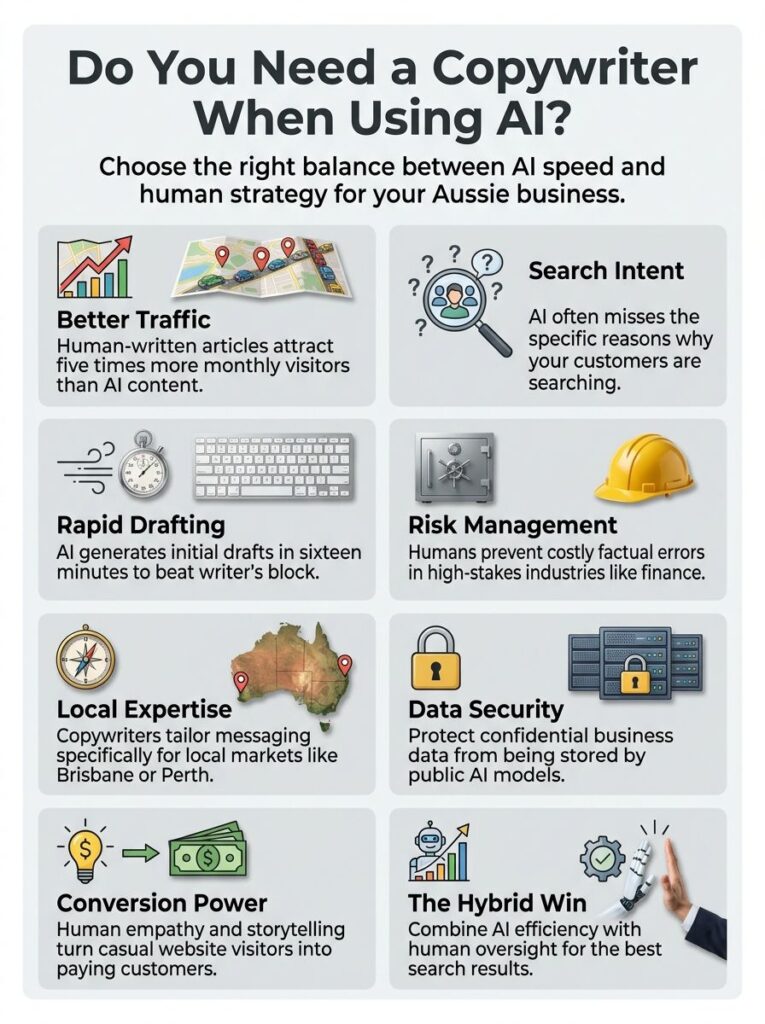
Neil Patel’s research makes that gap very clear. Human-written articles attract an average of 283 visitors per month, compared to just 52 for AI-generated articles. That’s nearly six times the traffic.
I’ve been watching this play out since founding Jeff Lee Copywriting in 2010. Over the last three years, I’ve researched this question carefully, tracked real results, and seen how clients respond to different content approaches.
Long-term clients have stayed loyal. New ones keep arriving. Several now request signed contracts guaranteeing no AI involvement in their work.
This article cuts through the hype. You’ll find out what AI actually does well, where it falls short for SEO strategy, and why the best results often come from combining both approaches.
By the end, you’ll have a clear answer that fits your goals and budget.
Key Takeaways
- Human-written articles attract 283 visitors monthly versus 52 for AI-generated content, making professional copywriters essential for SEO success.
- AI tools excel at drafting speed but struggle with keyword placement naturalness, search intent understanding, and strategic brand voice consistency.
- SEO copywriters target specific audiences through deep keyword research, search intent analysis, and customised messaging that drives conversions.
- Combining AI’s initial drafts with human copywriting expertise produces optimal results, balancing productivity gains with strategic quality improvements.
- Budget constraints and campaign urgency determine your choice: AI suits tight deadlines and bootstrap budgets, while human writers deliver superior long-term ROI.
Can AI Handle SEO Copywriting Effectively?
AI tools generate content quickly, but they often miss the mark on search engine ranking factors that matter most. I’ve watched artificial intelligence produce technically correct copy that fails to connect with real people or rank where it counts.
How Does AI Generate Content?
Generative AI works like a very sophisticated predictive text machine. These systems reduce words to numbers and output content based on patterns learned during training, essentially predicting what word should come next.
Tools like ChatGPT, Microsoft Copilot, Google Gemini, Jasper, and HubSpot AI Content Writer all function this way. They learn from vast amounts of internet content and use that knowledge to generate articles, blog posts, and SEO tags efficiently, making content creation significantly faster than traditional methods.
According to a January 2026 report by Australian digital marketing agency Firewire Digital, 82% of businesses are now using AI tools for content creation and reporting 59% faster production times as a result. That’s a significant shift, and it explains the pressure so many website owners feel to keep up.
In my years at Jeff Lee Copywriting, I’ve found that AI genuinely excels at drafting and productivity. These tools cut through the heavy lifting of initial composition, producing various types of written content from blog posts to product descriptions.
Yet this speed comes with real trade-offs. AI struggles with search engine optimisation nuances, audience targeting, and understanding true search intent. The systems lack the strategic thinking that separates mediocre copy from persuasive web content that actually converts visitors into customers.
That’s where copywriting expertise matters most for local businesses seeking real results.
What Are the SEO Limitations of AI?
AI systems struggle with search engine ranking because they force keywords into content unnaturally. I’ve watched AI tools jam phrases into sentences where they don’t belong, creating copy that reads like a machine wrote it.
Natural language processing has improved, yet AI still can’t match how real copywriters weave keywords into flowing prose. Search engines reward content that feels genuine to readers.
The 2026 Edelman AI Trust Barometer survey revealed that 81% of consumers trust human-authored brand content, compared to only 9% who trust fully AI-generated material. That’s not a small gap. It directly affects how your audience responds to everything you publish.
Beyond trust, here are the key SEO limitations that hold AI content back:
- Clunky keyword placement signals low quality to Google’s ranking algorithms
- Content draws from existing internet material rather than generating truly original work, raising plagiarism concerns
- Data shared with AI platforms is retained for model training, creating real privacy and security risks
- AI cannot understand true search intent or audience behaviour at a strategic level
- No access to your specific business context, industry nuances, or customer pain points
Samsung experienced security issues when confidential data entered AI platforms, and that’s a cautionary tale worth keeping in mind. My clients also worry about plagiarism detection because these tools don’t generate entirely original content.
AI detectors produce mixed results too. One case involved a student named August whose original coursework was flagged as 94% AI-generated by detection software. That shows how unreliable these tools can be for content verification.
Content marketing demands authenticity that AI struggles to deliver consistently. Keyword optimisation requires understanding search intent, audience behaviour, and competitive positioning. AI tools optimise for keywords alone, missing the deeper strategy behind why people search for specific terms.
AI generates content fast, but copywriters generate results that matter.
Advantages of Hiring an SEO Copywriter
A skilled SEO copywriter brings deep knowledge of keyword strategy and search engine ranking that goes well beyond what AI algorithms can deliver. I’ve seen website owners transform their organic search results when they pair strategic copywriting skills with genuine audience engagement rather than relying solely on automated content creation.
How Do SEO Copywriters Target Specific Audiences?

Targeting specific audiences starts with understanding what your customers actually search for online. Generic content misses the mark every time. Good SEO copywriting involves researching your local market, studying your competitors, and identifying the exact phrases your audience types into Google.
This search intent research shapes every word I write, so your content speaks directly to people who are ready to buy. The goal is brand messaging that resonates with your community, not some imaginary crowd on the other side of the country.
My approach combines audience engagement with conversion rate optimisation. That means analysing who visits your website, what keeps them scrolling, and where they drop off. Then I rebuild your web copy to guide visitors toward action.
Local marketing demands this level of attention. A plumber in Brisbane needs very different messaging than one in Perth. Content must be customised for each client’s specific goals, audience, and market conditions, so your web traffic converts into real customers.
A February 2026 case study by Australian SEO agency Creative Orbit found that human-authored web pages rank an average of 4.4 positions higher in Google search results than purely AI-generated pages. That’s a tangible, measurable advantage that compounds over time as your content library grows.
This results-driven approach has helped startups and large corporations alike climb search rankings while building genuine connections with their communities.
Why Is Expertise in Keywords and Search Intent Important?
 Keyword research forms the backbone of effective web copywriting. Proper keyword placement throughout your content boosts visibility in organic search results without triggering Google penalties from keyword stuffing.
Identifying search terms that match your audience’s real needs prevents wasted effort on irrelevant traffic. Content aligned with actual user intent attracts visitors who are ready to engage with your business.
A nuanced approach to keywords and search intent leads to higher organic traffic and improved business conversions.
Understanding search intent separates average content from a genuine conversion machine. Web copy that answers the specific questions your audience asks keeps visitors on your pages longer. They move through your sales funnel more readily.
I’ve watched businesses transform their digital marketing results by shifting focus from keyword volume to keyword relevance. This strategic approach to content strategy drives real results for website owners serious about growing their online presence.
Combining AI with Human Copywriters
AI writing tools generate first drafts fast, but they miss the strategic thinking that drives real results. Combining AI’s speed with strong copywriting skills produces content that ranks well and actually converts your visitors into customers.
How Can AI Tools Improve Content Drafts?
AI tools transform content drafting by accelerating productivity and cutting the time spent staring at a blank page. These platforms shine at brainstorming, drafting, and overcoming writer’s block, which makes them genuinely useful for website owners juggling multiple projects at once.
Here’s what the hybrid workflow actually looks like in practice:
- AI generates initial drafts rapidly, cutting production time significantly compared to starting from scratch manually.
- Brainstorming sessions move faster when AI suggests angles, headlines, and structural approaches.
- Writer’s block dissolves quickly because AI provides starting points that spark creative momentum.
- SEO tags and meta descriptions emerge with keyword integration already built in, saving time on technical formatting.
- Editing workflows improve because you refine a polished draft rather than wrestling with raw ideas.
- The production process follows a clear path: AI brainstorm, human draft, quality edit, then publish.
According to 2026 industry data from Firewire Digital, 62% of high-performing marketing teams now use a hybrid model rather than relying on full AI automation. That tells you something important: the top performers aren’t choosing one over the other.
The real power emerges when I combine these technological advantages with human expertise. That leads us directly into why skilled copywriters remain essential for strategic content development.
What Human Insights Enhance Strategic Content?
Human insights transform content from functional to exceptional. Storytelling rooted in real experience creates an emotional connection that algorithms simply cannot replicate.
Clients see better engagement when authenticity is woven into their copy. Readers sense genuine understanding, not machine-generated filler. Empathy shapes how a copywriter addresses audience pain points, and asking the right questions about your customers leads to responses that truly resonate.
Originality comes from real research into the industry, the competitive landscape, and customer behaviour. That credibility builds trust faster than generic content ever could.
Here’s what only a human copywriter can genuinely bring to your content:
- Storytelling drawn from real professional experience and industry knowledge
- Empathy that recognises what your customers genuinely worry about
- Market observations that come from years of working across different industries and audiences
- The ability to synthesise complex research into a compelling, readable narrative
Strategic content demands more than keyword placement. Creativity flows from lived experience and genuine insight into what motivates people to act. No AI tool can access a copywriter’s personal observations about market trends and customer psychology.
Andrea Thompson reaffirmed this truth: depth, creativity, and strategic insight stem from life experience and empathy. The result is content that engages, converts, and establishes your brand as an authority in your space.
Should I Choose AI or a Human Copywriter?

Your choice between AI and a human copywriter depends on what you’re trying to achieve and how much you’re willing to spend. Let me walk you through the factors that should guide your decision.
How Do Project Complexity and Goals Affect This Choice?
Project complexity and goals shape whether AI or human copywriting serves you best. Simple campaigns with straightforward messaging benefit from AI’s speed and volume. A product launch needing three landing pages? AI drafts those quickly.
Complex campaigns are a different story. Building a multi-channel strategy for a brand overhaul requires human copywriting because it handles campaign strategy with nuance that algorithms miss.
Projects that emphasise accuracy and trust require human writers. Financial services, healthcare, and legal sectors cannot afford AI’s occasional slip-ups. The stakes are too high.
A 2026 analysis of Australian search trends by Creative Orbit highlighted that in these sensitive sectors, purely AI-generated content faces harsh Google search penalties due to a lack of human E-E-A-T signals. E-E-A-T stands for Experience, Expertise, Authoritativeness, and Trustworthiness, and Google weighs these signals heavily when ranking content.
| Project Type | Best Approach | Why It Works |
|---|---|---|
| Simple product descriptions or social updates | AI-assisted | Speed and volume matter more than depth |
| Brand overhaul or multi-channel campaign | Human copywriter | Nuanced strategy and brand voice consistency |
| Health, finance, or legal content | Human copywriter | E-E-A-T compliance and accuracy requirements |
| Ongoing SEO blog content | Hybrid approach | Balances speed with strategic quality |
Blending both approaches often delivers optimal results. AI handles routine tasks like initial drafts and content variations, freeing me to focus on strategy and refinement. That means less time on repetitive work and more time crafting messaging that resonates with your specific audience.
Project complexity also influences budget and timeline. Straightforward campaigns cost less with AI assistance. Complicated initiatives with multiple touchpoints and audience segments require human expertise, which costs more but protects your investment.
I’ve seen website owners choose AI exclusively, only to find their content lacks the trustworthiness that converts visitors into customers. The most effective outcomes come when AI’s efficiency is paired with human judgement on every piece.
How Should Budget and Time Influence Your Decision?
Here’s how your financial capacity and timeline shape whether AI or a human copywriter makes sense for your business.
| Factor | AI Copywriting | Human Copywriter |
|---|---|---|
| Time Investment | AI generates content in roughly 16 minutes per article. This speed works brilliantly when deadlines loom. Multiple drafts emerge within hours rather than days. | Human writers spend approximately 69 minutes per article. That extra time allows for deeper research and audience analysis. Long-term SEO benefits justify the slower pace. |
| Budget Constraints | AI drafts cost significantly less upfront. Scaling content volume without proportional spending increases remains possible. Bootstrap businesses find real relief here. | Higher investment upfront reflects expertise and results. Human content outperforms AI by 4.1 traffic per minute versus 3.25 for AI. Better long-term value emerges through improved engagement and conversions. |
| Campaign Urgency | Time-sensitive launches benefit from AI’s efficiency. Rapid content cycles suit seasonal promotions well. Speed becomes your competitive advantage here. | Strategic campaigns reward the investment in depth. Audience targeting precision improves conversion rates. Search intent understanding sharpens messaging impact. |
| Hybrid Approach | Blending both methods stretches budgets smartly. AI handles initial drafts; I refine them with strategic insights. This combination reduces my time investment while maintaining quality standards. Your budget covers human expertise for high-impact pages only. | |
| Cost-Benefit Trade-off | Cheap content that underperforms wastes money regardless. Investing slightly more in human copywriting generates better traffic and engagement. Neil Patel’s testing showed humans deliver superior results per minute spent. My experience with Australian businesses confirms this pattern. Short-term savings often cost more in missed conversions later. | |
Your financial situation and timeline genuinely dictate the best path forward. Bootstrap budgets might start with AI drafts, then layer human expertise as revenue grows. A 2026 data intelligence report by Amra & Elma confirmed that content operations blending AI with human teams achieve up to 42% higher ROI and five times the output speed compared to using just one method exclusively.
Established businesses often skip AI entirely, knowing quality copy drives their competitive edge. Seasonal campaigns with tight deadlines suit AI’s speed well. Ongoing SEO strategy demands human insight and audience understanding.
Neither option wins in every situation. Context determines everything.
Conclusion
AI writing tools can draft content quickly, but they cannot replace the strategic thinking that SEO copywriters bring to your website optimisation efforts. My experience shows that clients demand original, persuasive copy that connects with their audience and drives organic search results.
The data is clear. Human-written articles attract nearly six times more visitors than AI-generated ones. Blending AI for initial drafts with professional copywriting skills creates the strongest digital marketing approach.
Your content quality and search engine ranking depend on this partnership between technology and human expertise.
FAQs
1. Can AI replace an SEO copywriter completely?
No, it can’t. AI platforms like ChatGPT produce content at speed, but they miss the human connection that builds trust. I shape your brand voice in a way that resonates with your audience and drives real results.
2. What does an SEO copywriter do that AI cannot?
I understand your audience’s pain points and craft content that speaks directly to them with keywords woven in naturally. Tools like GPT-4 can’t match that human insight for what makes your readers engage and convert.
3. Is it cost-effective to hire an SEO copywriter alongside AI tools?
Absolutely. I use AI tools like Jasper for first drafts, then polish the output to match your brand voice and keep your content strategy on track.
4. How do AI tools and SEO copywriters work together?
Think of AI as the engine and me as the driver. Platforms like ChatGPT generate drafts quickly, but I steer the content towards your goals and make every word earn its place on the page.