

Have you noticed good pages slipping in Google even though the copy looks fine and the backlinks are still there? That is usually the moment Sydney website owners realise rankings are no longer driven by keywords and links alone.
When I started auditing local sites, I kept seeing the same pattern: thin author bios, vague claims, weak proof, and almost no trust signals. Google added the extra E for Experience in December 2022, and its March 2024 update pushed even harder toward helpful, original content instead of scaled pages built just to rank.
I founded Jeff Lee Copywriting in Australia in 2010, and across years of web content and local SEO work I have found that strong SEO copywriting now needs evidence, credibility, and a better user experience from the first scroll.
In this guide, I will walk you through what E-E-A-T means, why it matters for Sydney websites, and the practical fixes I use to strengthen content credibility and organic traffic.
Key Takeaways
- Google added Experience to E‑E‑A‑T in December 2022, which made first-hand knowledge a clearer part of how content quality is assessed.
- E‑E‑A‑T is not a single direct ranking factor, but it strongly shapes the signals Google uses to judge helpfulness, credibility, and trust.
- The March 2024 Core Update and related spam policy changes targeted scaled, unoriginal, and manipulative content, whether it was produced by AI, humans, or both.
- Sydney sites do better when they show real credentials, complete business details, clear authorship, local proof, and a trustworthy user experience.
- HTTPS, fast hosting, accurate Business Profile details, expert bios, case studies, and mentions from respected organisations all help strengthen E‑E‑A‑T.
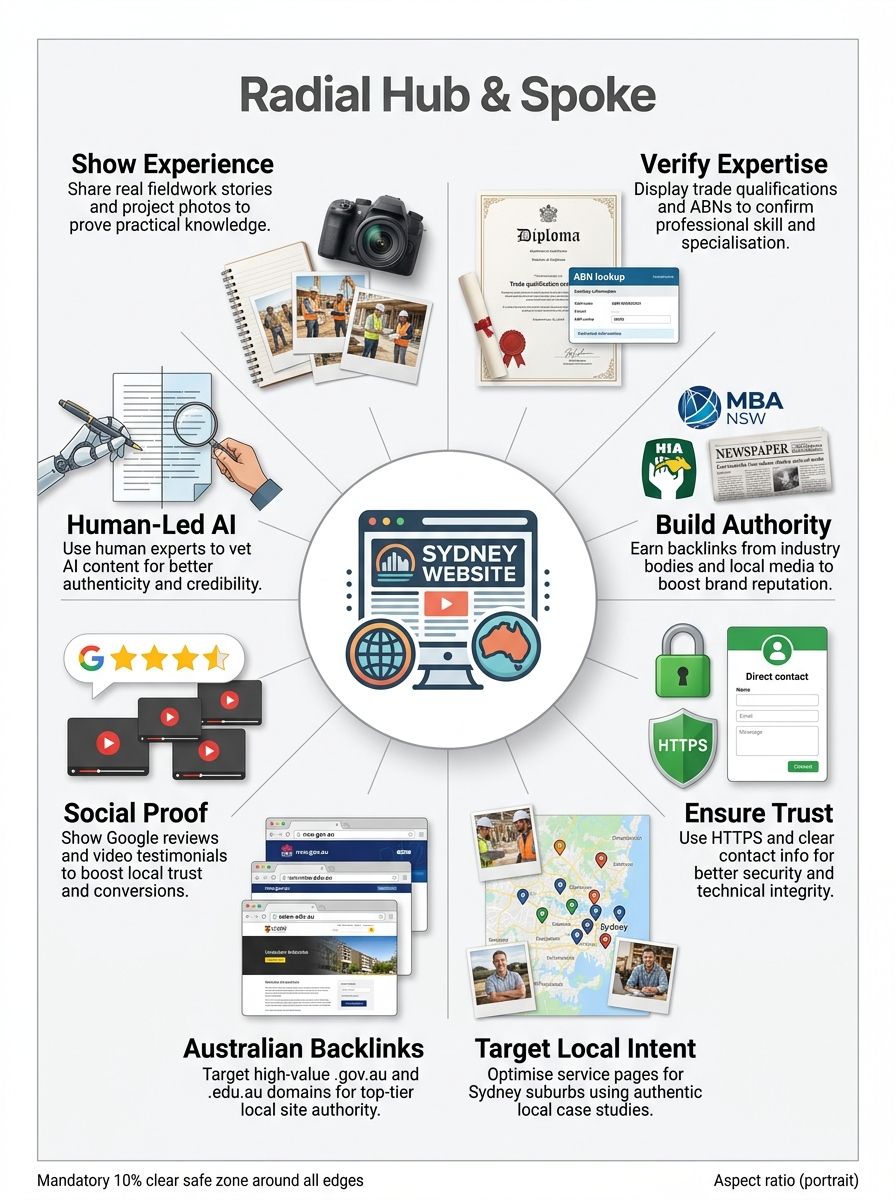
What Does E-E-A-T Stand For?
E-E-A-T stands for Experience, Expertise, Authoritativeness, and Trustworthiness. For Sydney website owners, it is one of the clearest ways to think about content quality, content credibility, and the signals that support long-term Google ranking.
Google added Experience in its December 2022 update to the Search Quality Evaluator Guidelines. That change mattered because it separated lived, practical knowledge from general knowledge.
I treat E-E-A-T as a working checklist, not a buzzword. If a page cannot show who wrote it, why they are qualified, what proof backs the claims, and why a visitor should trust the business, it is usually harder to rank and even harder to convert.
| Element | What Google wants to see | What that means for your site |
|---|---|---|
| Experience | Evidence of real use or real work | Case studies, original photos, project details, lessons learned |
| Expertise | Knowledge and skill in the topic | Qualifications, service depth, accurate explanations, specialist bios |
| Authoritativeness | Recognition from others | Mentions, reviews, industry memberships, quality backlinks |
| Trustworthiness | Safety, accuracy, and transparency | HTTPS, contact details, policies, honest claims, updated content |
What is Experience in E-E-A-T?

Experience means real-life engagement with the topic. Google made that explicit in December 2022, which is why pages written from actual work, use, testing, or problem-solving often feel more convincing than polished summaries.
I draw on years of fieldwork in marketing, communications, and web content and local SEO because that lets me explain what actually improves visibility, not just what sounds right in theory.
A Sydney solar installer who explains how they diagnosed storm damage, dealt with roof access, and restored panel output shows stronger experience than a page that only repeats manufacturer features. The same applies to accountants, lawyers, tradies, dentists, and any other service business.
- Original job photos: These show the work is real, and they also make your page harder to copy.
- Specific process details: Mentioning materials, suburbs, timelines, or constraints adds believable depth.
- Lessons learned: A quick note on what went wrong, and how you fixed it, often becomes the most persuasive part of the page.
- Named examples: Real project types, software used, or customer problems solved make the content feel grounded.
For website owners, the practical move is simple: replace generic claims with evidence from work you have actually done. That is how you turn content credibility into trust signals people can see.
How is Expertise Defined in E-E-A-T?

Expertise is the depth of knowledge behind the page. It can come from formal qualifications, years on the tools, specialist training, or a clear record of solving the same kind of problem repeatedly.
For a Sydney plumber, that could mean a visible NSW licence check, years in operation, and a page that explains hot water system options in plain English. For a mortgage broker, it could mean MFAA membership, lender expertise, and detailed guidance for first-home buyers. For a copywriter, it may be a body of results-driven case studies and a clear process for creating high-quality pages.
Google does not say every small business needs academic credentials. What it does reward is clarity about who is giving the advice and why they should be trusted on that topic.
The most overlooked fix I see is weak attribution. A page can be well written, but if readers cannot tell who created it or what qualifies them, expertise stays invisible.
For YMYL topics, meaning pages that can affect money, health, safety, or major life decisions, expertise matters even more. If you operate in law, finance, health, or regulated trades, make your qualifications impossible to miss.
What Does Authoritativeness Mean for E-E-A-T?
Authoritativeness is about reputation beyond your own website. It answers a blunt question: do other credible people or organisations treat your business as worth referencing?
That recognition can show up through quality backlinks, media coverage, association listings, partner mentions, awards, expert quotes, or strong branded searches. It is less about volume and more about the quality and relevance of the recognition.
A family law firm featured by a respected community organisation, a builder listed by an industry body, or a medical clinic cited in local media all gain authority because someone else has effectively vouched for them.
- Industry associations: Good for service trust and local credibility.
- Local media mentions: Useful when they highlight expertise or community work.
- Consistent directory listings: Helpful when your name, address, and phone details match everywhere.
- Branded search demand: A sign that people know your business by name, not just by category.
In practice, I look for authority gaps first. If a business has excellent services but no outside proof, I know the site needs stronger off-site signals before it can compete well in search.
Why is Trustworthiness Crucial in E-E-A-T?
Trustworthiness is the foundation of E-E-A-T. Google’s own guidance puts special weight on trust, because a page that looks polished but feels unsafe, vague, or misleading can still be a poor result.
I split trust into two parts: technical integrity and human credibility. Technical integrity covers HTTPS, working forms, accurate business details, privacy pages, and a site that loads properly. Human credibility covers honest claims, clear authorship, reviews, realistic promises, and proof that the business exists and serves real clients.
| Trust signal | Why it matters |
|---|---|
| HTTPS | Protects forms and reduces hesitation on enquiry pages |
| ABN, address, phone | Shows the business is identifiable and accountable |
| Named authors | Helps readers judge the source behind the advice |
| Updated content | Prevents old information from undermining credibility |
| Real reviews and case studies | Provides social proof that visitors can assess quickly |
If a page asks for money, personal details, or trust in an expert decision, these signals stop being optional. They become part of the sales process as much as the SEO strategy.
Why E-E-A-T Is Essential for Sydney Websites
Sydney is a competitive search market. In crowded service categories, strong E-E-A-T helps your website look safer, more useful, and more relevant than other pages offering roughly the same thing.
That matters because local customers often compare several businesses quickly. If one site has detailed bios, suburb-specific examples, recent reviews, and a complete Business Profile, while another offers only broad claims, the stronger page usually wins more clicks and more trust.
For local SEO, E-E-A-T also supports the signals Google says matter in local rankings: relevance, distance, and prominence. A trustworthy site helps every one of those factors work harder.
How Does Google Reward Genuine Expertise?
Google rewards genuine expertise by surfacing pages that appear helpful, original, and trustworthy. It does not publish a neat score for this, but its public guidance keeps pointing in the same direction.
In the March 2024 update, Google said it was improving Search to show less content made to attract clicks and more content people find useful. It also expanded its spam policies to target scaled content abuse, expired domain abuse, and site reputation abuse.
That is why shallow articles assembled for search engines, with no real author, proof, or oversight, often struggle to hold rankings. Strong pages tend to do the opposite: they show who created the content, why it is accurate, and what unique value it gives the reader.
- Publish expert bios beside service and blog content.
- Add proof such as case studies, screenshots, quotes, or job photos.
- Review pages regularly so facts, offers, and business details stay current.
- Remove filler that says little and replace it with useful specifics.
When I do this for local businesses, the content becomes easier to trust and easier for visitors to act on. Better engagement usually follows.
Why Should Sydney Websites Align with Local Search Intent?
Local search intent is where E-E-A-T gets practical. A Sydney customer searching for a solar installer in Miranda, a plumber in Surry Hills, or a family lawyer in Parramatta wants proof that the business serves that area and understands local needs.
Google Business Profile guidance says local results are mainly based on relevance, distance, and prominence. Complete business information, updated hours, reviews, and photos all help Google match a business to those searches.
So if you want stronger local visibility, your content needs more than a suburb list. It needs location-specific relevance.
- Create service pages that mention the suburb, service type, and common local problem.
- Use original project photos from real jobs in Sydney suburbs where possible.
- Add testimonials that mention service quality, outcome, or response time.
- Keep Business Profile details, website contact details, and service areas consistent.
This is one of the fastest ways to improve content credibility for location-based searches.
How Does E-E-A-T Build Trust with Target Audiences?

E-E-A-T builds trust by answering the questions people quietly ask before they enquire: Is this business real? Do they know what they are talking about? Can I rely on them?
For Sydney audiences, visible proof matters. A verified licence for a regulated trade, a real team page, a Business Profile with current hours, and recent customer feedback all remove friction.
If visitors have to hunt for who you are, where you are, or why they should believe you, the page is already working too hard.
That is why I prefer concrete proof over marketing puff. It improves user experience and makes the conversion path feel safer.
How Does E-E-A-T Impact SEO Rankings?

E-E-A-T affects SEO rankings indirectly but powerfully. It shapes the quality signals Google uses to decide whether your page looks reliable, helpful, and worthy of visibility.
That is why I do not treat E-E-A-T as separate from search engine optimisation. It sits inside content quality, user experience, online reputation, and the trust signals that influence whether people click, stay, and convert.
The important distinction is this: E-E-A-T is not a single switch inside the algorithm. It is a framework that improves the signals the algorithm can actually detect.
How Does Content Quality Indirectly Influence Rankings?
Content quality influences rankings because better pages satisfy search intent more clearly. That tends to improve click-through rate, time on page, return visits, and the chances of earning links or mentions.
I watch for pages that sound polished but say very little. They often have broad headings, stock phrases, no examples, and no sign that a real person knows the topic. Those pages struggle because they do not give visitors enough reason to stay.
By contrast, pages with useful detail, fresh examples, and obvious expertise usually feel easier to trust. They also age better after core updates.
- Refresh key pages every quarter if the topic changes often.
- Add a visible review date where accuracy matters.
- Update screenshots, offers, pricing cues, and service details.
- Replace generic intros with direct answers and real examples.
As a simple rule, if a competitor could swap in their business name and the article would still read the same, the content quality is probably too thin.
What Is the Connection Between E-E-A-T, PageRank, and User Engagement?

PageRank still matters because links help Google discover pages and estimate their importance. But links alone do not guarantee strong website ranking if the page itself looks weak or untrustworthy.
I think of it this way: PageRank can open the door, E-E-A-T helps you stay in the room, and user engagement shows whether visitors found what they needed.
| Signal area | What it does | Why it matters |
|---|---|---|
| Backlinks | Pass authority and discovery signals | Help pages compete in tougher search results |
| E-E-A-T | Supports credibility and quality perception | Makes the page feel safer and more useful |
| User engagement | Shows whether visitors interact and stay | Often improves when content matches intent well |
When these three areas line up, organic traffic is usually more stable. When one is missing, growth tends to stall.
Strategies to Strengthen E-E-A-T on Your Website
If you want stronger E-E-A-T, the best place to start is with the pages that make money or build trust. That usually means your homepage, service pages, About page, contact page, and the blog posts that already attract search traffic.
I look for the fastest fixes first: clearer authorship, stronger proof, better local relevance, and technical trust signals that reduce friction.
How to Showcase Credentials and Expertise Effectively?
I help Sydney businesses turn credentials into visible proof. The goal is not to brag. It is to remove doubt.
- Add full author pages with a photo, real name, short bio, and links to relevant profiles so both readers and search engines can identify the person behind the content.
- List years of experience, service areas, and licences where they matter. For regulated trades in NSW, licence verification is available through Fair Trading, so showing the licence number can speed up trust.
- Publish certifications, memberships, partnerships, or specialist training in the places people actually look, especially service pages and About pages.
- Show notable clients, projects, awards, or measurable outcomes where client permission allows it.
- Attach short bios to blog posts so expertise is connected to each article, not buried on one team page.
- Use schema markup, including Person or Organisation schema where appropriate, to reinforce authorship and business details.
A good test is this: if someone lands on one page from search, can they understand who you are and why you are qualified within ten seconds?
Why Publish First-Hand Experience and Case Studies?

Case studies give visitors something far stronger than a promise. They show the work, the context, and the result.
I like them because they support three goals at once: stronger Experience signals, better content credibility, and easier conversions.
- Use descriptive filenames and captions for project images so the page stays organised and easier to understand internally.
- Explain the job clearly, such as the suburb, the problem, the fix, and any technical challenge that made the work unique.
- Add a short testimonial with permission, especially one that mentions speed, communication, quality, or the outcome.
- Include numbers where they help, like turnaround time, lead increase, quote value, or repair scope.
- Link related service pages and supporting articles so the case study strengthens your internal topical authority.
The common mistake is making a case study sound like an ad. The better approach is to make it sound like useful evidence.
How to Build a Cluster of Authoritative Internal Links?

Internal links help search engines and readers understand how your content fits together. They also help stronger pages pass attention and authority to supporting pages.
I build clusters around real service themes, not random blog topics. That keeps the site useful for people and easier to crawl.
- Link service pages to related FAQs, cost guides, and case studies.
- Use anchor text that describes the destination naturally.
- Update older articles with links to newer, stronger pages.
- Keep key pages within a few clicks of the homepage.
- Group content by topic so each cluster supports one main intent.
This improves user experience because visitors can keep moving toward the exact answer they need, instead of hitting a dead end after one article.
How Does Securing Your Site with HTTPS and Fast Hosting Help?
Technical trust still matters. A page can have excellent content, but if it loads slowly, throws browser warnings, or feels clunky on mobile, visitors will lose confidence fast.
Google’s local guidance also stresses complete and accurate business information, so technical and business trust signals need to work together.
- Use HTTPS so enquiry forms, payment pages, and contact submissions feel safe to complete.
- Choose fast hosting with Australian infrastructure or a strong local delivery setup to improve speed for Sydney users.
- Add an ABN, phone number, and street address where appropriate so the business feels real and accountable.
- Run PageSpeed Insights, GTmetrix, and Google Search Console checks regularly to catch speed, indexing, and mobile issues.
- Compress images, use modern formats, and reduce heavy scripts that delay important content from appearing.
- Watch Core Web Vitals, especially LCP, INP, and CLS, because they reflect real loading, responsiveness, and visual stability.
A fast, secure page does more than support search engine optimisation. It makes visitors more willing to read, trust, and enquire.
Off-Site Tactics to Boost E-E-A-T
Off-site signals help confirm what your website says about you. If your site claims expertise but no one reputable mentions, reviews, or references the business, your online authority stays limited.
This is where backlinks, PR, reviews, and community recognition become more than marketing extras. They support trustworthiness and domain authority at the same time.
How to Earn Backlinks from Credible Australian Sources?
I focus on backlinks that make sense for the business, not random placements that only look good in a report. Relevant links from credible Australian sources tend to be far more useful than a pile of low-quality directory links.
- Contribute helpful articles to industry bodies, trade publications, or respected local business publications.
- Seek mentions from government, university, community, or association pages when your expertise fits the topic.
- Join local chambers, business groups, and reputable directories that have real editorial standards.
- Share original research, pricing trends, survey findings, or case data that journalists and editors may reference.
- Use expert quote services and direct outreach to comment on local or industry stories.
The smart question is not “How many links can I get?” It is “Which links would genuinely improve my reputation if a customer saw them?”
How Can PR and Media Mentions Improve E-E-A-T?
PR and media mentions improve E-E-A-T because they create third-party validation. When a known publication, podcast, or organisation features your business, it gives readers a quick reason to trust you more.
- Add a simple “As seen in” section if the coverage is genuine and relevant.
- Highlight media mentions that showcase expertise, not vanity placements.
- Include publication dates where recency affects credibility.
- Use a dedicated press or media page if you have multiple features, awards, or interviews.
- Turn strong stories into reusable proof across service pages, proposals, and author bios.
Done well, PR supports search visibility and conversion rate together. It tells both Google and real people that other sources recognise your authority.
Why Encourage User Reviews and Testimonials?
Reviews are one of the clearest trust signals for local businesses. Google Business Profile help notes that more reviews and positive ratings can support local prominence, and helpful replies can help your business stand out.
- Ask for reviews soon after a successful job, while the result is still fresh in the client’s mind.
- Use prompts that encourage specifics, such as speed, communication, cleanliness, or outcome.
- Feature testimonials on the pages where they help a decision, not on one isolated page only.
- Respond to reviews because active replies show the business is present and accountable.
- Pair reviews with case studies when possible so social proof and hard evidence work together.
I have found that detailed reviews usually outperform vague praise. “Arrived same day and fixed a leaking hot water system in Newtown” does far more for credibility than “Great service.”
E-E-A-T in the Era of AI and Generative Search
AI can speed up drafting, research organisation, and content planning. It cannot replace judgement, lived experience, or accountability.
That is even more important now because search results increasingly favour concise, trustworthy answers. If your content sounds synthetic, generic, or poorly checked, it becomes easier to ignore.
What Is the Role of Human Expertise in AI-Driven Content?
Human expertise turns an AI draft into something worth publishing. Google has said the issue is not AI by itself, but scaled, low-value content made mainly to manipulate rankings.
My rule is simple: AI can help me move faster, but it does not get the final say. I review facts, add local context, rewrite weak claims, and insert the proof that makes the page believable.
- Add original examples from client work or industry experience.
- Check every factual claim that affects a decision.
- Remove generic filler and unsupported advice.
- Make the answer clearer, simpler, and more useful than the draft started out.
That editing layer is where content quality usually rises or falls.
How to Balance Automation with Authenticity?
The safest balance is to automate the repetitive parts and keep the trust-building parts human. Research outlines, topic clustering, and draft structures can be assisted. Brand voice, expert judgement, and final verification should not be handed off blindly.
I also keep author bios, service details, and review dates current because stale trust signals weaken otherwise strong pages. In a market where AI can produce endless average content, authenticity becomes part of your competitive edge.
| Use automation for | Keep human-led |
|---|---|
| Outlines, summaries, draft structure | Fact checking, claims, strategy, and final editing |
| Keyword grouping | Search intent decisions and local nuance |
| Content briefs | Expert insight, examples, and proof |
If a page affects money, safety, health, or reputation, the human review step should be especially strict.
Conclusion
What Is E-E-A-T And Why It’s Now The #1 SEO Ranking Factor For Sydney Websites? In practical terms, it is the clearest way to explain why some sites earn trust, visibility, and enquiries while others fade, even with decent copy.
I focus on content quality, trustworthiness, authoritativeness, and user experience because those are the signals that support stronger organic traffic over time.
Show your credentials, publish real local proof, keep your site fast and secure, and give visitors solid reasons to believe you. That is how E-E-A-T turns from theory into better search engine optimisation and a stronger online reputation.
FAQs
1. What is E-E-A-T?
E-E-A-T stands for Experience, Expertise, Authoritativeness and Trustworthiness. It tells search engines if content and the people behind it are credible for Sydney websites.
2. Why is E-E-A-T the top SEO ranking factor for Sydney websites?
Search engines now favour content that proves real experience and clear expertise, especially for local queries. Think of it as a local judge, giving higher scores to sites that show solid proof and honest reviews.
3. How can a Sydney website lift its E-E-A-T score?
Show author bios with real credentials and local experience, cite trusted sources, collect customer reviews and keep content current. Optimise local listings and make contact details obvious so users and search engines trust your site.
4. Will improving E-E-A-T boost my traffic fast?
Not like a flick of a switch, no. Good E-E-A-T builds steady, lasting gains when you pair it with solid on-page SEO and helpful content.