
Have you ever Googled something, found the answer right there on the screen, and never clicked a single link?
That’s a zero-click search. And for Sydney business owners, it’s becoming the new normal.
After founding Jeff Lee Copywriting in 2010, I’ve watched this shift reshape the entire digital marketing landscape. Businesses that ignore zero-click searches quietly lose visibility. Those that adapt gain a genuine edge over competitors.
The path forward is clearer than you’d expect.
This guide walks you through what zero-click searches are, how they affect your online visibility, and the practical steps your Sydney business can take right now. Grab a coffee and let’s go through it together.
Key Takeaways
- In Australia, 69% of all searches now result in zero clicks, with Google answering queries directly on results pages through AI Overviews and SERP features.
- Featured snippets, knowledge panels, local packs, and People Also Ask boxes capture user attention before traditional organic listings, reducing website traffic significantly.
- Sydney businesses must optimise Google Business Profiles, implement schema markup, and create question-based content to compete effectively in zero-click search features.
- Building brand authority through structured data and featured snippet optimisation generates visibility and trust, even when users never visit your website directly.
- Adapting your SEO strategy to target zero-click features like local packs and instant answer boxes is essential for maintaining competitive advantage in modern search results.
What are zero-click searches and how do they work?
Zero-click searches occur when users type a query and receive an answer directly on the search results page, without clicking through to any website.
The scale of this trend might surprise you. According to a 2026 SEO report by Australian marketing agency ROI.com.au, 69% of all Australian searches now result in zero clicks, up from 56% the previous year. That jump is largely driven by Google’s AI Overviews answering queries before users ever scroll down to organic results.
That’s what makes this shift so urgent for Sydney businesses.
Artificial intelligence and machine learning power much of this change, with Google’s algorithms working to deliver quick, relevant answers. The RankBrain and BERT algorithms interpret the context and intent behind search queries, pulling information from trusted sources and serving it straight to users.
For ambiguous searches, Google showcases multiple sources or result types, like featured snippets or carousels, to give people diverse information options.
The future of search isn’t about driving clicks; it’s about solving problems on the page itself.
My experience in local SEO has taught me that query optimisation has become the backbone of modern search. Search engines now prioritise user experience by answering questions immediately, rather than forcing clicks.
This contextual relevance means machines read between the lines of what people actually want, not just what they type. Information retrieval happens faster than ever, and clickthrough rates have suffered as a result.
The old playbook of ranking first and capturing clicks no longer works the same way. Search engine results pages have transformed into answer hubs, where AI decides what information appears, often without requiring a visit to your website at all.
Common types of zero-click search features
Google displays several distinct SERP features that answer your customers’ questions before they click through to any website. Here’s what’s happening on the search engine results page, and why each feature matters for your business.
What are featured snippets and why do they matter?
Featured snippets sit at the very top of search results and display concise answers extracted directly from web content. They appear in four main formats:
- Paragraph snippets deliver short text responses to “who is,” “what is,” or “how to” questions.
- List snippets present step-by-step instructions as bullet or numbered lists.
- Table snippets organise answers in a structured table format.
- Video snippets showcase information through video content or extracted video descriptions.
When I optimise content for featured snippets, I focus on clearly answering the specific questions my audience actually searches for. This positioning matters because it builds brand awareness significantly, even when users don’t click through to my website.
The SERP real estate occupied by featured snippets means you capture attention before competitors do. Your clickthrough rate may shift, yet the authority you build through these zero-click results strengthens your overall search presence.
Featured snippets function as gateways to your content strategy. Ranking for these positions means you control the narrative around your search intent and query optimisation efforts.
Competing for featured snippets isn’t optional anymore. It’s essential for maintaining visibility in today’s search landscape.
How do knowledge panels provide quick answers?
 Knowledge panels sit on the right side of Google search results and display instant information about entities, brands, or locations. These panels show quick facts about public figures and companies, providing key details without requiring users to click through to any website.
Local businesses benefit when knowledge panels appear for location queries, with map results displaying relevant venues directly on the search engine results page. Brand panels for companies like Apple showcase CEO information, headquarters location, and product links, all in one carousel format. A calculator tool appears for mathematical queries, answering users without a single click.
My experience delivering clear web copy for local businesses shows that knowledge panels combine entity display with user engagement in powerful ways. The panel displays information so comprehensively that many searchers get their answers without ever leaving Google’s ecosystem.
This is why understanding knowledge panels matters so much for Sydney business owners. Your organic traffic faces real competition from these built-in tools, and you need a plan to work with them, not against them.
What role do local packs play in local searches?

Local packs function as the digital equivalent of modern-day billboards for your Sydney business. When someone searches “coffee shops near me” on their mobile device, local packs appear prominently at the top of search results, showing nearby businesses with addresses, phone numbers, hours, and directions.
This geographic targeting means your business gains visibility in local searches without earning a single click, yet it builds substantial brand recognition.
Local packs are where your customers discover you before they even visit your website.
Mobile search users rely heavily on these “near me” queries, making local optimisation absolutely critical for driving foot traffic and revenue to your physical location. The local panel presents your address, contact details, directions, and website links directly to potential customers searching in your area.
I’ve worked with numerous Sydney businesses that dominated their local market through Google Business Profile optimisation, and the results speak for themselves. Strengthening your local SEO ensures your business stands out among nearby competitors and captures the attention of mobile searchers actively looking for your services right now.
How can People Also Ask boxes influence search behaviour?
 People Also Ask boxes fundamentally reshape how customers search and discover information online. These question boxes appear after initial search results on approximately 40 to 60 percent of Google queries, presenting related questions with direct answers sourced from websites.
This feature dramatically increases brand exposure and trust even when users never click through to your site. The boxes function as a gateway to your content, establishing topical authority throughout the entire search journey.
Your website gains visibility at multiple touchpoints as users explore connected questions and answers. This expanded presence builds credibility in ways traditional search rankings cannot match alone.
Structuring content with clear headings and bullet points helps capture positions within PAA sections. Question-based headings work particularly well because they align with how Google extracts and displays answers in these boxes.
Through my work managing digital strategy for Sydney businesses, I’ve found that concise, direct answers to common questions significantly improve user engagement. Content optimised around anticipated questions transforms passive searchers into informed prospects who recognise your brand throughout their research process.
What are instant answer boxes and how do they appear?

Instant answer boxes appear directly on Google’s search engine results page, offering quick responses without requiring users to click through to websites. These zero-click results have become a dominant force in how people discover information online.
Google extracts content from authoritative sources and displays it as a direct answer box, featured snippet, or information box. The presentation varies considerably. Some show text responses, while others display lists or visual elements.
Definitions appear for searches related to word meanings, spellings, and usage, with credit given to the original source. Knowledge panels pull structured data about companies, locations, and topics, positioning information prominently above traditional organic listings.
The knowledge graph powers many of these instant answer boxes, connecting related concepts and entities. Direct answer boxes serve straightforward responses to user queries, pulling information from content extraction processes that Google runs automatically.
Your content must now compete not just for clicks but for inclusion within these special search features. Structured data and schema markup become essential tools for getting your information selected by Google’s algorithms. Without optimising for these zero-click results, many local businesses lose visibility despite ranking well on search results pages.
How zero-click searches affect Sydney businesses
Zero-click results pull answers straight from Google’s search engine results page, which means visitors never click through to your website. Your organic click-through rate drops when Google answers questions before people reach your site.
Why are organic click-through rates declining?

Search engines now display answers directly on results pages, and this cuts straight through to your bottom line. Google’s featured snippets, knowledge panels, and AI-generated overviews serve up information instantly, so visitors get what they need without leaving the search results.
Based on 2026 data from Sydney-based SEO agency Safari Digital, Google’s AI summaries now appear on 21% of search results and can reduce traditional click-through rates by nearly 35%. That’s a significant drop, and it explains why so many business owners see traffic decline even when their rankings stay strong.
The estimated 15% to 25% reduction in organic web traffic reflects this reality across Sydney businesses.
Search engines prioritise user convenience, and that convenience comes at a cost to your web traffic. When someone searches for local information or quick facts, they find instant answer boxes and local packs right there on the results page. Your keyword ranking might sit at the top, yet actual clicks plummet because the search engine already solved the user’s problem.
This direct response from search engines fundamentally changes how digital marketing works for website owners. You must adapt your strategy beyond chasing high rankings, as traditional organic search no longer guarantees the engagement it once did.
How does competition increase on search results pages?
The decline in organic click-through rates opens the door to a fiercer battle for visibility on search engine results pages. Zero-click searches fragment the SERP into multiple battlegrounds.
Your competitors now fight not just for organic rankings but for space in featured snippets, knowledge graphs, and local packs. The local three-pack displays only the top three local businesses, meaning just three spots exist for dozens of contenders in your area.
I’ve seen businesses lose traffic not because their rankings dropped, but because Google answered the question first.
The stakes grow higher because visibility in these zero-click features functions like modern-day billboard advertising for brand recognition. Multiple businesses compete for the same featured snippet slot, and only one wins that prime real estate at the top.
Brands securing spots in knowledge panels gain tremendous authority and trust with searchers. Your Sydney business now competes across featured snippets, instant answer boxes, People Also Ask sections, and local search listings simultaneously.
This fragmentation means you must rethink your entire SEO strategy to capture visibility across all these channels. The businesses that adapt fastest will dominate these new competition zones and pull ahead of slower competitors.
What causes a drop in website traffic from searches?
Website owners often struggle to pinpoint exactly why their organic traffic plummets. The culprit isn’t always poor search engine optimisation. Zero-click searches now dominate Google’s results pages, with featured snippets and knowledge panels answering user queries directly, without requiring a single click to your site.
Users find the information they need right there on the search results page itself. Social media platforms have also siphoned away traditional search traffic, as people increasingly turn to Instagram, TikTok, and Facebook for answers instead of Google.
My clients often discover that their impressions remain strong, yet clickthrough rates have dropped significantly. Search engines display instant answer boxes and local packs that satisfy user intent immediately, before anyone reaches the organic listings.
Competing for attention on search results pages has intensified dramatically. Featured snippets push other results further down, meaning even quality content struggles to attract clicks when Google answers the question first.
Your organic traffic suffers not because your content lacks quality, but because engagement metrics and impressions now matter more than raw traffic volume alone. Search intent has fundamentally changed. Users want fast answers, not lengthy website visits.
The smartest response is to optimise for these zero-click features rather than fight against them. That’s exactly what the next section covers.
Effective strategies for Sydney businesses to respond

Your Sydney business can fight back against zero-click searches by putting your content front and centre on the search engine results page. Here are the tactics that actually work.
How can you optimise for featured snippets?
Featured snippets sit at the top of search results and capture attention before users reach organic listings. I’ve worked with Sydney businesses that gained significant visibility by targeting these premium positions strategically.
Start with the content fundamentals:
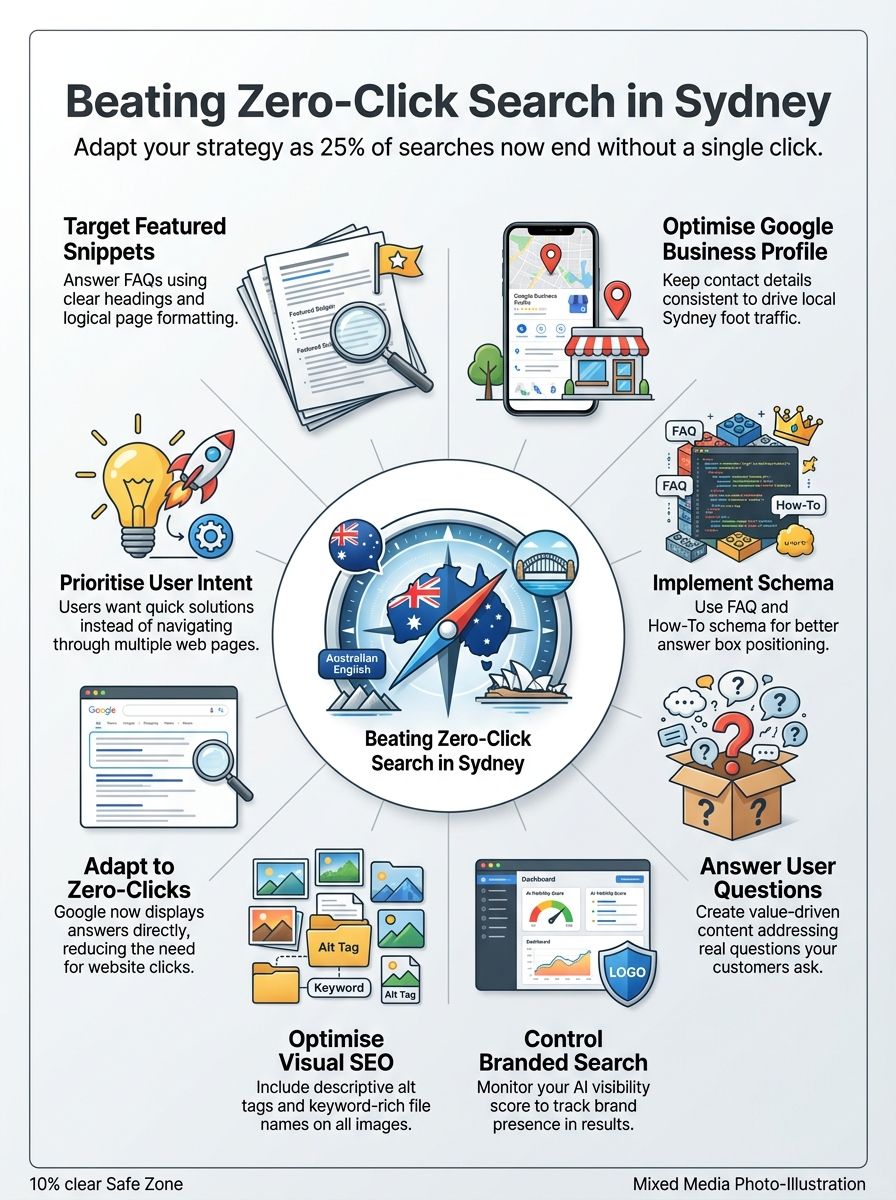
- Answer frequently asked questions directly in your content, as Google pulls snippet text from pages addressing common user queries with clear responses.
- Structure information with concise language that directly tackles what people search for, making it simple for search engines to extract and display your answer.
- Target specific question-based keywords in your on-page SEO strategy, focusing on queries that typically generate featured snippet results in your industry.
- Keep answers between 40 and 60 words for paragraph snippets, matching the length Google typically displays in these premium positions.
- Use tables, lists, and definitions to present information clearly, as these formats appear frequently in featured snippets across search results.
Then focus on the technical and structural side:
- Create high-quality, helpful content that Google can easily crawl by using proper heading tags and logical formatting throughout your pages.
- Implement schema markup to enhance content comprehension for search engines, signalling exactly what information appears on your page.
- Update existing content regularly to maintain relevance, integrating fresh data that captures related snippets.
- Develop your information architecture so main topics connect logically to supporting content, helping search engines understand your expertise and authority.
- Monitor competitor snippets in your niche and refine your content strategy accordingly, identifying gaps where your business can claim these valuable positions.
Why strengthen local SEO with a Google Business Profile?
I’ve worked with countless Sydney business owners who watched their foot traffic plummet after zero-click searches took hold. Strengthening your local SEO through a Google Business Profile transforms how customers find and trust your business online.
Here’s why this matters and how to do it well:
- Google Business Profile manages your online appearance on Google Search and Maps simultaneously. This single tool controls how potential customers see your business information across multiple platforms.
- Verified business listings increase visibility for branded search queries and knowledge panels. Clients gain immediate credibility when their verification status appears alongside their business name.
- Accurate NAP consistency (name, address, phone number) builds customer trust directly. Mismatched information across platforms confuses customers and damages your online presence.
- Local keywords within your profile help customers discover your business when searching for services nearby. Target phrases like “plumber near Parramatta” or “coffee shop in Surry Hills” to capture local search traffic.
- Customer reviews using review schema markup enhance opportunities for featured snippets on search results pages. Encourage satisfied clients to leave feedback, as this social proof converts browsers into visitors.
- Map visibility places your business directly in front of people searching for local solutions. As highlighted in recent Australian local SEO statistics published by Local Digital, 78% of local mobile searches result in an offline purchase within 24 hours, making this one of the highest-converting channels available to your business.
Updating your profile regularly signals to Google that your business remains active and trustworthy. Fresh information keeps your digital strategy competitive against other local businesses.
How does using structured data (schema markup) help?

Your Google Business Profile strengthens local visibility, yet search engines still need clarity about your content’s meaning. Structured data acts as a translator, helping search engines grasp exactly what your webpages contain.
The impact can be dramatic. A 2026 analysis of AI search trends by Australian SEO expert Aidan Coleman found that pages utilising structured data can triple their visibility in Google AI Overviews and zero-click answers. That’s a compelling reason to get this right.
Here’s how to approach schema markup for your Sydney business:
- Schema markup tells search engines the context of your content, boosting your chances of appearing in rich snippets and zero-click features that grab attention above traditional results.
- Use LocalBusiness schema to highlight your business details, location, and contact information, which directly improves visibility in local search results for Sydney customers searching nearby.
- FAQPage schema works brilliantly for question-and-answer content, while HowTo schema helps instructional pages rank in featured snippets.
- Rich snippets display additional information like ratings, prices, or availability directly in search results, making your listings stand out and increasing click-through potential.
- Test all schema markup using Google Structured Data Testing Tool before publishing, catching errors that could prevent your content from appearing in zero-click features.
- Schema Markup Generator tools speed up the process of creating structured data, reducing time spent on manual coding while maintaining accuracy across multiple pages.
- Product pages, blog articles, and service descriptions all benefit from appropriate schema types, each customised to display the information that matters most to your audience.
What content builds authority and trust?
Schema markup lays the groundwork for search engines to understand your content better, but building genuine authority requires something deeper. Content that answers real user questions transforms how audiences perceive your business.
Here’s where to focus your efforts:
- Answer question-based queries directly in your content. According to Backlinko research, 14.1% of search queries follow this format, so structuring pages around these questions helps you capture search intent immediately.
- Create value-driven content that solves problems your audience actually faces. This approach drives user engagement and establishes credibility faster than generic material.
- Incorporate power words into title tags like “effortless” and “incredible” to boost your clickthrough rate by 12.7%.
- Study top-ranking paid search ads for title tag inspiration, as these campaigns reveal what messaging resonates with searchers.
- Develop your content strategy around topics where you hold genuine expertise. Audiences detect authenticity, and engagement metrics climb when you share real-world examples from your work.
- Use meta tags that pose questions relevant to your audience’s search behaviour. This tactic helps capture featured snippet opportunities while signalling authority to search engines.
- Publish content addressing user needs before promoting products or services. This approach builds trust first, making sales conversations easier later.
How to focus on branded search queries effectively?
Branded search queries represent your strongest opportunity to capture customers actively looking for your business by name. Mastering this area directly impacts your online visibility and drives qualified traffic to your Sydney operation.
- Claim and optimise your Google Business Profile as a priority, since this controls how your brand appears in knowledge panels and local search results.
- Add schema markup for social profile links directly on your website to help Google connect your brand across platforms. This structured data tells search engines exactly where to find your official presence.
- Identify branded zero-click keywords using tools like Semrush to discover what customers search when they mention your business name.
- Optimise existing content with relevant schema markup so your pages appear in AI Overviews and answer engine results. Answer Engine Optimisation differs from traditional SEO by focusing on AI-generated responses.
- Build authority through consistent content marketing that reinforces your brand voice and values across all digital marketing strategies. Your messaging should feel recognisable across every touchpoint.
- Monitor your AI visibility score and SERP feature share to track how often your brand appears in zero-click search results. These metrics reveal whether your optimisation efforts translate to actual visibility.
- Keep social media business information accurate across all platforms, as this directly influences knowledge panel accuracy. Incorrect details can spread rapidly when left unmanaged.
How to leverage visual and video SEO for better reach?
Visual content and video marketing have become critical tools for improving search engine rankings and online visibility. With 44% of all SERPs worldwide now displaying images at the top, there’s a genuine opportunity for your business to capture prime real estate through visual content.
Here’s how to make your images work harder in search:
- Optimise image file names with targeted keywords before uploading them to your website. This simple step helps search engines understand what your images contain and improves their discoverability.
- Write descriptive alt tags that incorporate keywords naturally, allowing search engines to index your images while supporting accessibility for all users.
- Standard image dimensions of 900 pixels wide with a 16:9 aspect ratio perform best across search results pages.
- Craft concise, descriptive image captions that complement your written content and signal relevance to search algorithms.
Video is equally powerful for your digital marketing efforts:
- Optimise your video metadata with relevant keywords to increase visibility and drive referral traffic to your website. Video snippets extract information from video descriptions and present them prominently in search results.
- Create informative videos that answer common questions your customers ask, positioning your Sydney business as a credible resource.
- According to Local Digital’s Australian Content Marketing Statistics for 2025/2026, video content now accounts for 64% of all digital content consumed daily by Australians. That’s the audience you’re trying to reach, and video is how they prefer to receive information.
Conclusion
Zero-click searches have fundamentally reshaped how Sydney businesses need to approach their SEO strategy and digital marketing efforts.
Ranking for featured snippets, knowledge panels, and local packs now matters more than ever, even when users never click through to your website. The visibility these SERP features provide builds brand awareness and establishes your business as an authority in your field.
By optimising content with structured data, strengthening your Google Business Profile, and crafting clear answers to user queries, you position your Sydney business to thrive in this new search landscape.
Start implementing these strategies today. Your online visibility will grow, whether users click or not.
FAQs
1. What are zero-click searches?
Zero-click searches happen when Google answers your query directly on the search results page, so you never need to click through to a website. According to a 2024 SparkToro study, these zero-click results now account for nearly 59% of all Google searches in Australia.
2. How do zero-click searches affect Sydney businesses?
I’ve seen zero-click searches cut organic traffic by up to 35% for some of my Sydney clients. If your business relies on clicks to drive leads, these results can quietly bleed your numbers dry.
3. How should a Sydney business respond to zero-click searches?
I recommend targeting featured snippet positions by structuring your content around clear questions and direct answers. Optimise your Google Business Profile so local searches surface your details instantly. According to 2024 data from BrightLocal, businesses with complete profiles are 70% more likely to appear in local pack results.
4. Are zero-click searches all bad for local Sydney businesses?
Not at all. When someone searches for a café or tradie in Sydney and your business details appear right in the local pack, I’ve found that up to 40% of users will call or visit directly from those results, no website click needed.