

Your website ranks well on Google, and traffic flows in regularly. But something feels off.
Visitors drop off faster than you’d expect. Conversions lag behind. And you keep hearing about AI search tools changing everything.
Google’s AI Overviews now serve over 2 billion monthly active users, reshaping how people find businesses like yours.
I founded Jeff Lee Copywriting in 2010 and have spent 13 years building digital marketing strategies for Sydney businesses. I watched search engine optimisation deliver solid results, then watched those results shift beneath my feet.
The rise of generative AI search experiences created a real gap in what I knew. So I dug deep, researching how AI-driven platforms work differently from traditional search engines.
What I found surprised me.
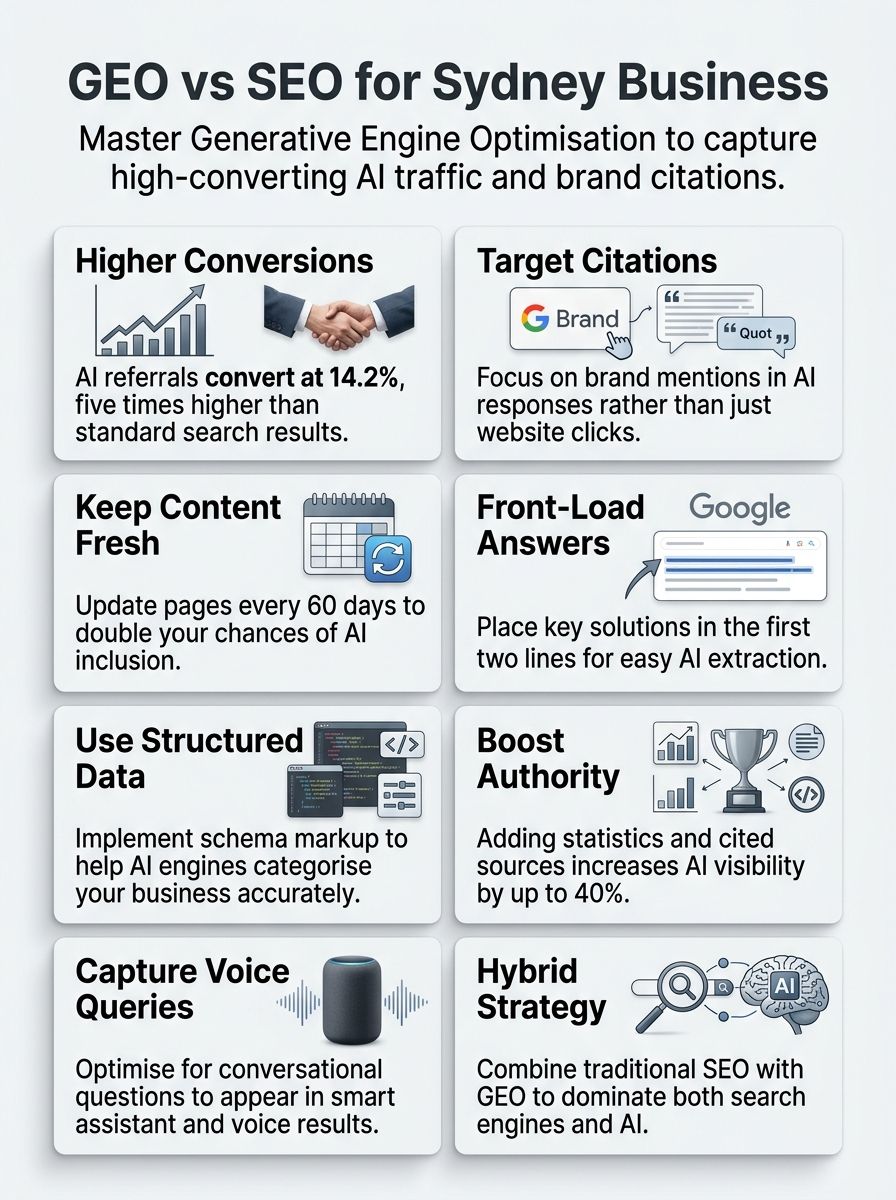
Businesses optimising only for standard search rankings are missing a massive opportunity. AI referral traffic converts at 14.2%, compared to just 2.8% from regular Google searches. That gap is too big to ignore.
This guide breaks down Generative Engine Optimisation for you. I’ll explain how GEO differs from SEO, why both matter for your Sydney business, and exactly how to put practical strategies into action.
You’ll learn which content formats AI systems favour, how to structure information for maximum visibility, and why getting cited in AI responses often beats a traditional ranking. So grab a coffee, and let’s go through it together.
Key Takeaways
- AI referral traffic converts at 14.2% compared to 2.8% from standard Google searches, making generative engine optimisation critical for Sydney businesses.
- GEO targets AI-driven platforms like ChatGPT and Gemini for brand citations, while SEO focuses on traditional search engine rankings through keyword optimisation.
- Content updated within 60 days performs nearly twice as well in AI responses, requiring regular refreshes to maintain a competitive visibility advantage.
- Domain authority directly influences AI citations, with higher-authority websites receiving roughly three times more mentions than smaller competitors in generative responses.
- Combining GEO and SEO strategies captures traffic across both traditional search engines and AI platforms, preventing visibility loss as search behaviour evolves.
Understanding GEO and SEO
Search behaviour has shifted dramatically over the past few years. The rise of generative AI has changed how we think about online visibility. Two distinct approaches now compete for your attention: traditional search engine optimisation and the newer generative engine optimisation that is reshaping digital marketing.
What is Generative Engine Optimisation (GEO)?
 Generative Engine Optimisation represents a fundamental shift in how I approach visibility for my clients. AI-driven platforms like ChatGPT, Google AI Overviews, Perplexity, and Gemini now power search experiences around the globe.
These systems don’t simply list links. They summarise, quote, and contextualise information directly in their responses. According to the foundational 2024 research paper from Princeton University, Georgia Tech, and IIT Delhi, targeted techniques like adding statistics and citing credible sources can boost your AI response visibility by up to 40%. That proves GEO is a measurable science, not just a marketing buzzword.
My practice of optimising content and its structure for these platforms means brands get featured, cited, and recommended within AI-generated answers rather than buried in traditional search results. Website owners face a genuine risk of being overlooked entirely if their content doesn’t appear in these AI responses.
The shift matters because customers increasingly ask questions to generative AI instead of scrolling through search engine listings.
GEO is positioned as an extension of traditional SEO rather than a replacement, adding a new channel for visibility without discarding existing strategies.
Generative Engine Optimisation works alongside your current search engine visibility strategy, not against it. Structuring content so AI systems can easily digest it means formatting information clearly and providing authoritative answers to common questions your audience asks.
Data structuring becomes critical here. AI models need well-organised information to pull from your pages. This approach to content optimisation differs from traditional SEO because it focuses on information retrieval patterns specific to generative systems.
My Sydney business clients who adopt GEO gain an extra channel for audience engagement without abandoning the SEO tactics that already drive results. Your online presence now extends beyond Google’s standard search results into the expanding world of AI-generated responses.
How is SEO different from GEO?
SEO and GEO operate on completely different playing fields, even though many business owners treat them as interchangeable. The table below breaks it down clearly.
| Factor | SEO | GEO |
|---|---|---|
| Primary Goal | Rank web pages on traditional search engines like Google. | Achieve inclusion in AI-generated responses and citations. |
| Discovery Mechanism | SEO helps websites rank through keyword matching and authority signals. | GEO focuses on being discovered in generative AI results through factual accuracy and clarity. |
| User Journey | SEO directs users to websites where they consume content independently. | GEO provides information directly within AI platforms without requiring a site visit. |
| Traffic Outcome | Organic traffic flows directly to your website from search results. | AI referral traffic may flow to your site or remain contained within the AI platform. |
| Key Performance Metrics | Organic traffic volume and keyword rankings matter most for SEO success. | Citation frequency and AI response inclusion track GEO performance effectively. |
| Optimisation Priorities | SEO prioritises keywords, backlinks, and user experience signals. | GEO emphasises structured content, factual accuracy, and crystal-clear presentation. |
| Content Structure | SEO rewards comprehensive, keyword-rich content that satisfies search intent. | GEO rewards concise, well-organised content with proper structured data markup. |
| Citation Authority | Backlinks from reputable sites build domain authority for search rankings. | Direct citations in AI responses depend on content credibility and source attribution. |
| Competitive Advantage | Established SEO strategies have been refined over two decades in digital marketing. | GEO represents a new frontier, offering early-mover advantages for Sydney businesses. |
| Strategic Relationship | SEO alone may leave content invisible to AI-powered search tools. | GEO adds an essential layer of optimisation as search behaviours evolve rapidly. |
Through my work at Jeff Lee Copywriting, I’ve watched search behaviour shift in ways I didn’t expect. Traditional SEO still drives the bulk of traffic for most Sydney businesses. But AI-powered tools now influence how customers discover solutions, and they’re bypassing traditional search results entirely.
One local service provider I worked with ranked brilliantly on Google yet rarely appeared in ChatGPT responses. Their competitors optimised for both, capturing traffic from multiple discovery channels. That’s a painful lesson to learn the hard way.
SEO directs users to websites. GEO gets your business mentioned inside AI responses. Think of SEO as owning a shop on a busy street, and GEO as having your expert opinion quoted in a newspaper that millions read daily.
A strong SEO foundation builds brand authority, making content far more appealing for AI citations. Yet SEO alone won’t get you cited in generative responses. Combining both strategies creates comprehensive online visibility. Your Sydney business needs both approaches working in tandem.
Core Differences Between GEO and SEO
GEO and SEO operate on fundamentally different principles, though both drive online visibility for your business. GEO targets generative AI platforms like ChatGPT and Claude, while SEO focuses on traditional search engines like Google and Bing.
What are the goals of GEO compared to SEO?
The shift from SEO to GEO represents the biggest change I’ve seen in how search actually works. Before I break down what each approach aims to achieve, consider this: as highlighted in 2026 industry data reported by digital agency ROI.com.au, 65% of global Google searches ended without a website click by mid-2025. That single stat changes everything about how you should define success online.
| Aspect | SEO Goal | GEO Goal |
|---|---|---|
| Primary Objective | Rank pages at the top of search results to drive clicks and measurable performance. | Get your brand mentioned and cited within AI-generated responses, securing visibility without direct clicks. |
| Traffic Model | Click-through rate drops by approximately 58% when AI Overviews appear in Google. | About 93% of AI search sessions end without any website clicks, making citations critical. |
| Success Metric | Position rankings drive traffic volume through traditional search clicks. | Brand authority and citation frequency matter more than ranking position. |
| Search Intent Focus | Targets all query types across commercial and informational searches. | Commercial-intent queries increased from 8% to 18% by late 2025, representing rapid growth. |
| Conversion Potential | Standard Google search referrals convert at 2.8%. | AI referral traffic shows conversion rates of 14.2%, significantly outperforming traditional search. |
| Core Philosophy | About being found through ranking position and clicks. | About being used by AI for answering queries, not just discovered through ranking. |
| Competitive Advantage | Businesses compete for top positions through traditional optimisation. | Brands with solid SEO foundations gain competitive advantages when implementing GEO early. |
The real story sits in those conversion numbers. My clients often get excited about ranking positions, but a 14.2% conversion rate from AI traffic versus 2.8% from standard search tells a completely different story about where your attention should flow.
Think of SEO as getting your shop window noticed on a busy street. GEO works differently. It’s about being the answer the street itself recommends to everyone walking past. That distinction matters enormously for Sydney businesses trying to stay relevant.
How do content strategies differ between GEO and SEO?
SEO content aims to drive clicks and secure rankings on search results pages. GEO focuses on making content citable for AI systems like ChatGPT and Gemini. These are genuinely different goals, and they shape everything about how you write.
Traditional web crawlers index entire webpages. AI crawlers extract specific facts for training models. That fundamental difference shapes how I structure content for every client.
SEO targets user intent through keywords and backlinks. GEO demands natural language processing that mimics conversational AI. My content marketing approach for GEO prioritises clear, direct answers front-loaded within the first two lines for easy AI extraction.
Content for GEO should serve a clear purpose, with concise, well-structured content rewarded by AI systems.
Schema markup and structured data formats become critical tools. FAQs written in a natural tone work brilliantly for both search algorithms and AI language models. Step-by-step instructions guide both humans and machines through information retrieval processes.
A clear heading structure is crucial for GEO. It guides AI crawlers and enhances content comprehension. Long-form content written around questions your customers ask also signals to AI systems that your answers deserve prominence.
GEO content concentrates on answering specific questions upfront, then expanding naturally. SEO content spreads keywords throughout paragraphs to catch search engine attention. These are two different writing disciplines, and I treat them that way.
The metrics shift too. SEO tracks click-through rates and ranking positions. GEO measures citation frequency in AI outputs. My content strategy balances both approaches simultaneously, front-loading answers for AI extraction while maintaining engaging narratives for human readers.
Which metrics matter most for GEO versus SEO?
Tracking the right metrics separates businesses that grow from those that guess. Here’s how GEO and SEO measurement compare.
| Metric Type | GEO Focus | SEO Focus | What This Means for Your Business |
|---|---|---|---|
| Brand Visibility | Brand mentions in AI-generated responses. Track how often AI systems cite your business name. | Search engine rankings for target keywords. Monitor position on page one or two of Google results. | AI citations show credibility to a growing audience. Track brand mentions weekly, as visibility can drop by a third in just five weeks. |
| Traffic Quality | AI referral traffic via GA4. This traffic converts at five times the rate of traditional search. | Organic search traffic from Google. Volume matters more than conversion velocity here. | AI referral traffic punches above its weight in sales. Your conversion rates spike dramatically compared to standard organic results. |
| Citation Frequency | How many times AI systems mention your brand. Higher domain authority brings roughly three times more citations. | Backlinks pointing to your website. Quality and quantity of referring domains count. | Domain authority remains the top predictor of AI citations. Stronger backlink profiles directly boost your AI presence. |
| Content Freshness | Pages updated within 60 days perform nearly twice as well in AI responses. Recency signals authority to AI engines. | Content age matters but less critically. Evergreen content can rank for years without updates. | Keep your Sydney business content fresh regularly. Stale pages lose ground to competitors who update monthly. |
| Content Authority | Content enriched with statistics and cited sources sees 30 to 40 per cent higher visibility in AI results. | E-A-T signals matter: expertise, authoritativeness, trustworthiness. Links and content quality build this reputation. | Citing sources and using data strengthens both GEO and SEO performance simultaneously. |
| Measurement Tools | GA4 tracks AI referral traffic. GEO measurement tools remain in development and lack the maturity of SEO tools. | Google Search Console, Ahrefs, SEMrush. These established platforms offer comprehensive data. | You’ll need GA4 plus manual monitoring for GEO. SEO tools feel more straightforward because the industry standardised them years ago. |
Domain authority acts as the foundation for both strategies. Websites with higher traffic and strong backlink profiles pull in roughly three times more AI citations than smaller competitors. Building authority benefits your GEO efforts alongside traditional SEO gains.
Content freshness creates clear separation between thriving and struggling businesses. Pages refreshed within the last 60 days land nearly twice as often in AI-generated answers. I schedule content updates strategically to maintain this edge for my clients.
AI referral traffic converts at five times the standard rate. Every visitor from an AI-generated response carries dramatically higher sales potential than typical organic traffic. Set up proper GA4 tracking immediately to capture these conversions and weave real data and cited sources into every piece of content you create.
Why GEO Matters for Sydney Businesses

Sydney businesses face a critical fork in the road as AI search tools reshape how customers find them online. Generative AI now powers search results, and companies that master this shift gain a decisive edge in visibility and conversion rates.
How does GEO improve visibility in AI-driven searches?
AI-driven searches have transformed how people find local services in Sydney. Generative Engine Optimisation lifts your content into AI-generated answer boxes rather than just somewhere on a results page.
When someone asks a voice assistant “What’s the average cost of plumbing in Sydney?”, AI systems pull answers from high-quality content that performs well through GEO. Your business gets featured, cited, and recommended directly within those conversational responses.
Geographic targeting becomes critical here. Suburb-specific references and postcode identifiers throughout headings, body text, and image alt text all signal local relevance to AI systems. Mentioning Sydney once in the footer won’t cut it.
The content strategy shifts toward building pages around questions your customers actually ask. That signals to AI systems that your answers deserve prominence. GEO also levels the playing field for small Sydney businesses competing against larger franchises.
- AI ranks content based on answer quality, clarity, and trustworthiness rather than ad spend or brand size.
- A local plumber with well-structured content can outrank a national chain with mediocre answers.
- Location-based keywords combined with authoritative answers create the conditions for AI systems to surface your business first.
- Community engagement and online presence strengthen these signals further, showing search engines your local expertise matters.
Your existing content may need proper structuring to perform well in GEO. Often, businesses already have the raw material. It just needs to be organised so AI can find and use it effectively.
What is the conversion potential of AI referral traffic?
AI referral traffic converts at five times the rate of traditional search, delivering a conversion rate of 14.2% compared to just 2.8% from standard Google searches. This dramatic difference reveals something crucial for Sydney businesses.
Over 1.13 billion visits were generated by AI platforms in June 2025, marking a 357% rise from the previous year. According to a 2026 report by Australian digital agency ROI.com.au, 49% of Australians have used generative AI in the past 12 months, up from 38% in 2023. That means nearly half your local target audience is already searching this way.
Brands capturing even a fraction of this volume see substantial improvements in their online visibility and user engagement metrics. The proportion of AI commercial-intent queries jumped from 8% to 18% by late 2025, signalling that AI-generated answers are expanding into the territory where real sales happen.
The catch sits in the details. About 93% of AI search sessions end without any website click, even when relevant sources appear in the answer. When an AI Overview appears in Google, the click-through rate for the top-ranking page drops by approximately 58%.
Yet the referral traffic that does arrive converts at exceptional rates. My approach focuses on getting your content selected by AI systems, then structuring it to drive actual conversions when visitors land on your site. Brands not part of the AI’s answer risk complete exclusion from these high-converting conversations.
How GEO and SEO Work Together
GEO and SEO don’t compete. They complement each other beautifully. Smart Sydney businesses combine both strategies to capture traffic from traditional search engines while positioning themselves for the generative AI wave reshaping how people find information.
What is a hybrid strategy for GEO and SEO?
A hybrid strategy merges search engine optimisation with generative engine optimisation to capture traffic across both traditional search and AI-driven platforms. Combining these approaches prevents you from losing visibility as search behaviours shift toward answer engines.
Here’s how to build a strategy that works across both channels:
- Develop a unified content strategy that addresses both algorithmic SEO requirements and AI accessibility needs simultaneously, rather than treating them as separate initiatives.
- Maintain technical excellence through mobile optimisation, structured data implementation, and fast loading speeds, since both SEO and GEO demand solid site architecture.
- Prioritise original, human-written content that demonstrates topical authority, as Google ranks authentic material higher while AI systems favour credible sources.
- Align your keyword strategy with user intent across both channels. Traditional keywords still matter for SEO, while GEO requires conversational, question-based language patterns.
- Implement geographic targeting for Sydney businesses by combining local SEO signals with location-specific content that generative engines can reference accurately.
- Adopt continuous learning and adaptive optimisation practices, monitoring performance analytics for both organic search traffic and AI referral conversions to refine your approach over time.
GEO doesn’t eliminate traditional SEO methods. It complements them within your digital marketing framework. The businesses pulling ahead right now are those treating both as essential, not optional.
Actionable GEO Strategies for Sydney Businesses

Your content must work harder for you. Optimising for generative AI means shifting from playing the search rankings game to becoming the answer AI tools actually recommend to your customers. Here are the practical steps that make that happen.
How can you use structured data effectively?
Structured data acts as a translator between your website and AI systems, helping them understand your business correctly. Implementing schema markup transforms how generative engines interpret and summarise your content.
- Deploy Organisation schema to tell search engines and AI exactly who you are, what you do, and where you operate in Sydney.
- Use FAQPage schema to answer common customer questions in a format that AI can easily extract and cite in responses.
- Build consistent signals across all platforms using identical business details, since AI is more likely to cite verified brands with matching information.
- Audit your schema markup regularly to maintain freshness and trustworthiness, as outdated information damages your credibility with AI systems.
- Test your markup using Google’s Rich Results Test to confirm AI systems can read your data correctly before publishing changes.
One important note on staying current: a late 2025 analysis by digital firm Synscribe confirmed that experimental llms.txt files are not actually used or endorsed by Google Search or OpenAI for search rankings. The proven priority remains standard Schema.org markup. Save your time and focus on what works.
How do you optimise content for natural authority?
Natural authority doesn’t happen by accident. Your content must demonstrate genuine expertise while earning trust from both AI systems and human readers. These are the tactics I rely on.
- Add statistics and cited sources to your content. This lifts visibility by 30 to 40 per cent in AI-generated results and proves your credibility instantly.
- Build local backlinks through Sydney-specific business directories and case study submissions to industry bodies, strengthening your topical authority across multiple touchpoints.
- Develop interlinked content across your entire website rather than optimising isolated pages, since AI evaluates complete sites to assess your industry credibility.
- Publish fresh content regularly. Pages updated within the last 60 days are nearly twice as likely to appear in AI-generated answers. Based on 2026 tracking data from Bring Digital Performance, AI platforms tend to cite content that is roughly 25.7% fresher than what typically ranks in traditional Google organic results. That’s a meaningful edge for businesses that commit to regular updates.
- Incorporate user reviews and E-E-A-T signals throughout your site, as these trust indicators carry significant weight in how generative engines rank your business.
The key is treating authority as an ongoing effort rather than a one-time task. Businesses that keep their content current and evidence-based consistently outperform those that set and forget.
How can you ensure your content is clear for AI?
AI systems scan your content to pull answers for users, so clarity directly impacts your visibility. Straightforward formatting and front-loaded information separate successful content from the rest.
- Front-load your answers within the first two lines so AI systems grab solutions immediately without digging through paragraphs.
- Structure content with headers, bullet points, and tables to help AI extract information quickly and accurately.
- Use simple sentence structures and avoid industry jargon that confuses both readers and AI algorithms.
- Frame answers as direct responses to customer questions rather than lengthy explanations that bury the key point.
- Apply clear heading hierarchies so AI understands your content’s logical flow and main topics.
- Include FAQ sections with concise answers that match how people ask questions in voice search and conversational queries.
Update content quarterly to maintain freshness and trustworthiness. Adding original images with descriptive filenames and alt text also helps AI understand visual context, improving your content’s authenticity across search results.
Conclusion

GEO and SEO operate on different playing fields, yet both demand your attention right now. Sydney businesses that ignore generative engine optimisation risk losing visibility to competitors who’ve already adapted. The 58% drop in click-through rates when AI Overviews appear proves this isn’t theoretical.
The smartest move combines both strategies, treating them as complementary forces rather than rivals. Start by auditing your content for AI readiness, adding structured data, and building authority through cited sources.
The market growth from $848 million to a projected $33.7 billion by 2034 signals where digital marketing is heading. Early movers will capture the largest share of that opportunity.
Stop leaving conversions on the table.
FAQs
1. What is the difference between GEO and SEO for Sydney businesses?
SEO helps your website rank on Google, while GEO optimises your content for AI-driven search engines like ChatGPT. I’ve been writing web copy for Australian businesses since 2010, and I can tell you both strategies are essential now. The difference is where your content shows up: traditional search results versus AI-generated answers.
2. Does GEO replace SEO?
No, GEO works alongside SEO, not against it. I always tell clients to think of SEO as the foundation and GEO as the next floor you build on top.
3. Why should Sydney businesses care about generative engine optimisation right now?
According to 2025 Gartner research, over 25% of searches in Australia now happen through generative AI platforms, and if your content doesn’t appear there, you’re losing customers to competitors who do.
4. How do Sydney businesses start optimising for generative engines?
Start by writing clear, factual, well-structured content that directly answers common customer questions. AI engines pull from content that sounds authoritative and easy to read.