

Have you ever pushed out a stack of content, watched your rankings flatline, and wondered what on earth you’re doing wrong?
It’s a pattern I hear from website owners all the time. You invest in AI tools, publish dozens of pages, and yet Google still isn’t impressed.
Here’s what I keep seeing: competitors using human copywriters keep pulling ahead. It’s not just a feeling. There’s a real reason behind it.
Since founding Jeff Lee Copywriting in Australia back in 2010, I’ve watched Google’s priorities shift dramatically. One thing has become clear: Google doesn’t penalise AI-generated content outright. What it penalises is poor quality content, regardless of how it was created.
That distinction matters enormously.
In this article, I’ll walk you through exactly why human creativity is winning in 2026, how E-E-A-T standards favour genuine expertise, and what a smarter content strategy looks like. I’ll also show you how to combine AI efficiency with human quality so your content actually works for you.
Key Takeaways
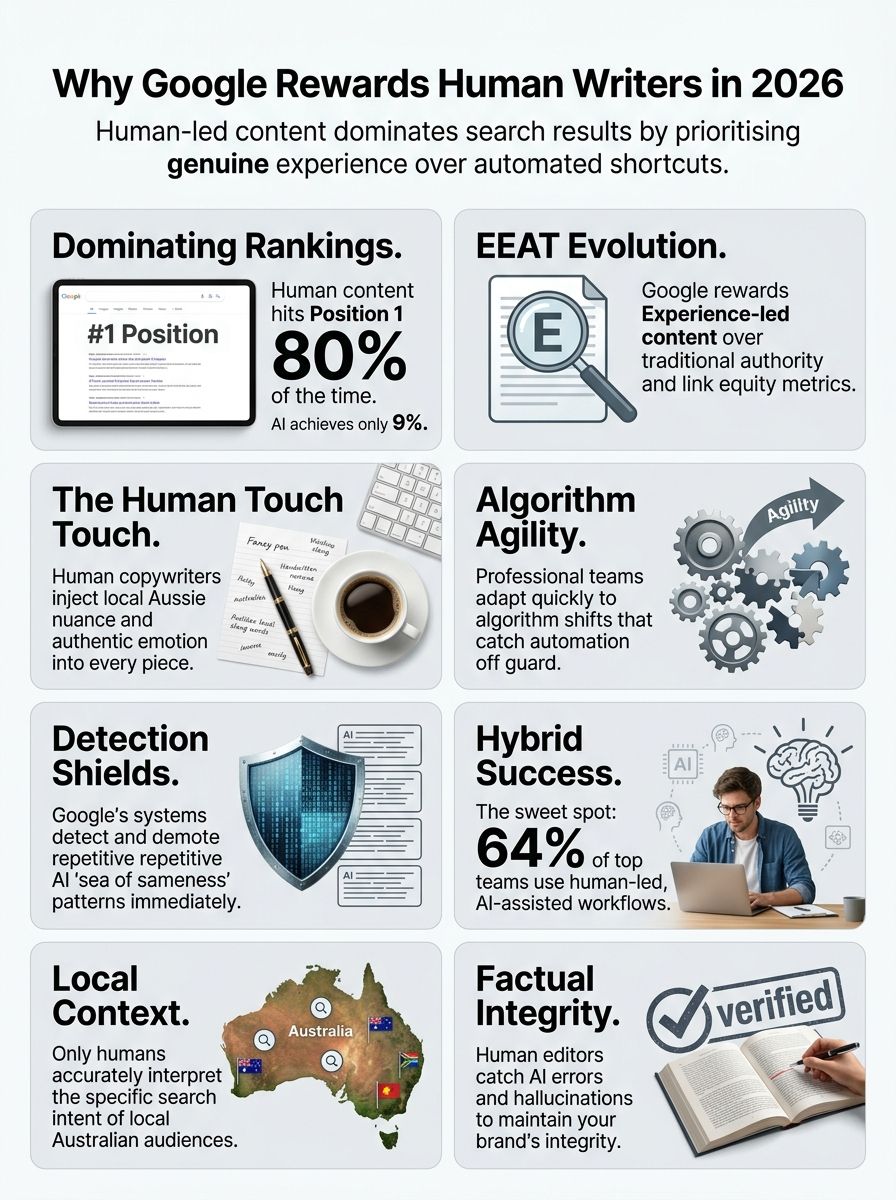
- Google rewards E-E-A-T signals (experience, expertise, authority, trustworthiness) over AI-generated content, with human-written material appearing in 80% of Position 1 rankings versus just 9% for pure AI.
- Human copywriters adapt faster to algorithm changes and compliance requirements, maintaining organic performance whilst AI-dependent strategies struggle after major Google updates.
- Mixed human-led, AI-assisted workflows outperform both pure approaches, with 64% of teams adopting this strategy for faster production without sacrificing quality or authenticity.
- AI-generated content fails to grasp local context, cultural nuance, and user intent, producing generic, repetitive material that lacks the emotional connection and contextual depth readers demand.
- Fact-checking and human editorial oversight transform AI drafts into credible content that meets Google’s 2026 standards, preventing hallucinations, compliance issues, and brand reputation damage.
Google’s 2026 Approach to Content Creation
Google shifted its focus in 2026 toward rewarding content that demonstrates genuine expertise, experience, authority, and trustworthiness. We call this E-E-A-T. I’ve watched this change reshape how search engines evaluate what deserves top rankings, and it fundamentally favours writers who bring real knowledge and human judgement to their work.
What is EEAT and why does it matter in 2026?

Search rankings shifted dramatically after the March 2026 core update, and one thing became crystal clear: E-E-A-T now drives everything. Experience, Expertise, Authoritativeness, and Trustworthiness form the foundation of how Google ranks content today.
Experience sits at the top of this pyramid, surpassing traditional metrics like authority and link equity. Sites showcasing genuine experience saw remarkable improvements, with 68% of websites displaying strong E-E-A-T signals climbing higher in search results after the update.
According to a February 2026 case study by Australian SEO agency Creative Orbit, human-authored pages rank an average of 4.4 positions higher than AI-generated pages, with 68% of top-ranking URLs authored by real humans. That’s not a marginal edge. It’s a structural advantage that compounds over time.
This shift affects every industry, but health and finance categories faced the harshest penalties when they lacked personal application or experiential insight. Vague content simply doesn’t cut it anymore. Google now rewards specific outcomes and documented methodologies that prove real-world credibility.
Author bios and structured author pages with verifiable credentials have become essential ranking factors. I’ve built my copywriting practice on transparency, and this change validates that approach completely.
- Experience: Concrete results, case studies, and proven track records that show you’ve actually done the work.
- Expertise: Deep knowledge in your field, demonstrated through specific and accurate content.
- Authoritativeness: Your reputation, built through consistent delivery and transparent communication about what you’ve accomplished.
- Trustworthiness: Verified credentials and honest, well-sourced content that readers can rely on.
Verification of credentials strengthens your authority across search engines. This shift means website owners must focus on original research and establishing author authority for better organic visibility.
“Experience is now the most crucial E-E-A-T factor, surpassing traditional metrics like authority and link equity.”
How does Google prioritise user-first content over automation?
Google’s algorithm focuses on content value, relevance, and search intent rather than penalising AI itself. The search engine rewards material that proves useful, original, and genuinely relevant to what users actually need.
Google targets mass-produced, low-value pages that lack context or utility, not the method used to create them. Content must match user queries and deliver reliable information with original ideas, not just repetitions of what already exists online.
The algorithm’s evaluation process prioritises quality over automation shortcuts. This means website owners benefit most when they put user-first content at the centre of their strategy, content that solves real problems for real people.
My approach at Jeff Lee Copywriting centres on creating informative content that serves people first and search engines second. I use AI tools for research and initial organisation, but every final piece carries genuine human value.
Expertise, personal stories, credibility, and nuanced explanations separate high-ranking content from generic alternatives. Google supports using AI for initial drafting and fact-gathering, yet the search giant makes it clear that humans must add substantive value throughout.
Website owners who invest in quality assurance and originality see their pages climb higher than those relying solely on automation. Search algorithms reward material created to help users, not material designed to manipulate rankings.
Differences Between Human and AI Content
Human copywriters craft content with genuine emotion and local insight that resonates with your audience. AI systems often produce generic text that lacks the contextual depth and creative flair your customers actually want to read.
How does human writing show creativity and emotional connection?
Since 2010, I’ve built my copywriting practice by crafting content that speaks directly to people. My clients see real results because every piece carries personal stories, experiences, and nuanced explanations that resonate.
Creativity flows through human writing in ways AI simply cannot match. I weave cultural understanding into narratives that connect emotionally with readers. My team works out what matters most to each audience, then builds authentic voice and empathy into the work.
We adapt tone and language dynamically, reflecting what your customers actually expect. Persuasion happens when readers feel genuinely understood, not when they read generic templates.
Emotional connection emerges from relatable narratives that carry real weight. Personal anecdotes and expert quotes build credibility far better than robotic lists. Writers and editors inject humanity and context into content that AI generates as flat, repetitive text.
“People connect with people, not algorithms. That’s why human copywriters will always outrank AI-generated content that lacks soul.”
Human copywriters understand nuance in ways machines don’t. Narrative and genuine connection transform website visitors into loyal customers. That’s the real power of creativity and authenticity in 2026.
What are AI’s limits with local and contextual content?

AI systems hit a wall when facing local and contextual demands. I’ve watched AI struggle to grasp what makes Australian audiences tick, and the evidence backs this up clearly.
AI relies on data patterns rather than real understanding of regional context. It misses the subtle cultural sensitivities that separate effective content from forgettable noise. A Semrush analysis of 42,000 blog posts revealed human-written content dominates Google’s number one position at 80%, compared to just 9% for AI-generated pieces.
This gap exists because AI cannot truly comprehend user experiences or the nuances that matter to specific communities. My clients in Melbourne, Brisbane, and Sydney need copy that speaks directly to their local market. AI produces generic content that fails to capture the regional flavour or audience engagement needed for strong search rankings.
- Personalisation demands genuine understanding of what drives people in a specific area.
- Cultural sensitivity requires more than pattern recognition. It demands lived knowledge.
- Local nuances in language, values, and consumer behaviour remain beyond AI’s reach.
- Content effectiveness suffers when algorithms generate text without grasping regional preferences.
AI’s fundamental limitation stems from its inability to reflect authentic human experiences and emotions within local contexts. The system processes information mechanistically, missing the tone adaptation required for different audiences and regions.
My hand-crafted copy consistently outperforms AI alternatives in local search rankings because it speaks directly to the communities I serve. AI-generated content often misses region-specific details that influence whether potential customers engage or move on.
Why Are Human Copywriters Leading in 2026?
Human copywriters dominate Google’s 2026 rankings because they craft content that speaks directly to real people’s needs. I’ve watched search results shift dramatically over the past few years, and the pattern is consistent: authentic human voices consistently outperform robotic AI text.
What do ranking stats say about human-written content?

The data tells a compelling story about what Google rewards at the top of search results.
| Ranking Position | Human-Written Content Performance | AI-Generated Content Performance | What This Means for Website Owners |
|---|---|---|---|
| Position 1 (Top Spot) | Appears 80% of the time according to Semrush analysis of 42,000 blog posts | Appears just 9% of the time | If you want to dominate Google’s top position, human-written content gives you an eight-fold advantage over pure AI output |
| Page 1 Distribution | Secures the highest-ranking spots across the board | Typically appears in lower Page 1 positions when it does rank | AI content struggles to break into premium real estate on Google’s first page |
| Industry Adoption Trend | 87% of content teams involve humans in development | Only 13% of teams rely solely on automation | The market has spoken. Professional content creators know human involvement drives better results |
| Mixed Strategy Success | 64% of teams use human-led, AI-assisted approaches | Fully automated workflows underperform consistently | The sweet spot lies in blending human creativity with AI efficiency, not replacing one with the other |
| Engagement Quality | Effective human-led workflows outperform fully automated content in both ranking and engagement | Generic and repetitive patterns emerge from AI-only strategies | Your audience connects with genuine human insight, and Google’s algorithm recognises this connection |
These statistics reveal a fundamental shift in how Google evaluates content quality. Websites leveraging human copywriting consistently climb higher in search rankings than those relying exclusively on automation.
An 80% to 9% advantage isn’t marginal. It’s a complete reversal of what some people expect about AI content performance. Website owners who ignore this data risk falling behind competitors who embrace human-written content.
- Human writers capture Position 1 nearly nine times more often than pure AI output.
- Competitive industries see this gap widen even further over time.
- Content featuring strong author bios and verifiable credentials reaches Position 1 more reliably.
The ranking stats make one thing clear: Google favours the human touch. Your next step is understanding why Google’s algorithm has become so selective about content quality and what specific markers separate top performers from the rest.
How do humans adapt better to Google algorithm changes?

I’ve watched Google’s algorithm shift dramatically since 2010, and human copywriters hold a distinct advantage when those changes hit.
My team responds to algorithm updates by introducing new data, case studies, and expert insights that keep content compliant with Google’s latest guidelines. We interpret and implement changes in spam and helpful content policies faster than any automation tool can.
Editorial oversight allows us to pivot quickly, emphasising experience and authority as these factors rise in importance. Content audits conducted by my writers catch gaps that algorithms miss, maintaining organic performance in competitive industries.
- Human writers introduce fresh perspectives and adjust messaging based on real-world performance data.
- They avoid penalties for vague or generic content by staying alert to policy changes.
- They refine existing content immediately when Google signals shift, often improving rankings in the process.
- They bring strategic thinking that static AI-generated material simply cannot replicate.
Brands relying solely on automation struggle after major updates because their content lacks the flexibility to respond to new compliance requirements.
This hands-on approach means my clients maintain visibility whilst competitors scramble to recover from ranking drops. The difference comes down to speed, insight, and strategic thinking. Human copywriters excel at quality control and compliance, which directly impacts how Google assesses your content value.
What Are the Risks of Using Only AI Content?
Relying solely on AI-generated content leaves your website exposed to generic, repetitive material that fails to connect with real people. Search engines now detect low-value AI output, and your rankings drop when Google spots content that lacks genuine human insight and authenticity.
Why can AI content become generic or repetitive?
I’ve watched countless AI tools produce content that sounds like it came from the same factory. Most generative AI systems draw from similar training data and follow comparable patterns, which creates a homogenisation problem across the web.
When multiple website owners use identical AI prompts, their outputs blend together into a sea of sameness. This repetition stems from AI’s reliance on existing patterns rather than fresh thinking. The tools lack the personal idiosyncrasies that make human writing stand out.
Generic or keyword-stuffed AI output receives lower rankings under Google’s 2026 algorithm because search engines now reward content with genuine depth and perspective.
The real danger lies in what researchers call “model collapse.” As recycled AI content gets fed back into training datasets, content diversity suffers dramatically. According to a February 2026 content marketing report by Onely, 74.2% of newly created webpages now contain AI text. That staggering volume is what’s driving model collapse forward, with each generation of AI-produced material becoming thinner and less nuanced than the last.
Bias creeps in too, since the same tools amplify the same viewpoints repeatedly. Clients who skip the refinement step produce particularly flat results because they don’t invest time in sharpening AI prompts, so output quality drops further.
Human copywriters bring creativity and contextual understanding that AI simply cannot replicate, especially for local markets where cultural nuance matters most.
How does AI struggle to understand user intent?
AI systems miss the mark because they rely on existing data patterns rather than genuine insight into what your customers actually need. I’ve watched AI tools produce content that sounds polished but falls flat with real people.
These systems lack the contextual awareness to grasp why someone searches for something specific. A person hunting for “affordable plumber near me” needs local expertise and trust signals, not generic tips about pipe maintenance.
AI generates content that frustrates users or fails to satisfy their needs because it cannot adapt tone, style, and recommendations for distinct audiences. Without human oversight, AI output misses the mark in addressing specific search intents that vary widely across different customer segments.
- Content relevance suffers dramatically when machines do the heavy lifting alone.
- Personalisation becomes impossible when algorithms cannot interpret nuanced user queries or evolving search behaviour.
- The gap between data patterns and real human needs grows wider every day.
- Audience engagement drops when content lacks the emotional connection and problem-solving depth that comes from someone who truly understands their world.
I’ve seen businesses lose organic visibility because their AI content failed to match searcher expectations, even though keyword placement looked perfect on paper. Human oversight transforms AI drafts into content that actually resonates with your target market.
Human copywriters interpret and respond to nuanced intent because we’ve spent years learning how people think and communicate. That’s where the real competitive advantage lives in 2026.
How Does Google Assess AI vs Human Content?
Google looks at whether real people wrote your content or machines produced it. My team and I have watched the search engine refine its detection methods to spot low-value AI-generated material and reward authentic human work that connects with readers.
Why are quality and relevance key ranking factors?
I’ve spent over a decade watching search rankings shift, and quality and relevance form the backbone of how Google ranks content in 2026. The algorithm prioritises content quality over the method of creation, which means it doesn’t matter if a human or an AI writes something. What matters is whether it answers what people actually search for.
Content must match user queries and provide reliable, up-to-date information to perform well. My clients who focus on delivering answers that solve real problems see their pages climb the rankings faster than those producing generic material.
Search engine ranking success depends on understanding that every piece of content competes based on how well it satisfies searcher needs. Websites delivering information reliability and contextual accuracy consistently outperform those cutting corners with thin, unhelpful pages.
Original ideas and unique value propositions are essential for top rankings because search engines reward content that brings something fresh to the table. As detailed in a March 2026 SEO analysis by Hobo Web, Google’s Helpful Content System now mathematically evaluates something called “Information Gain.” This metric rewards pages that offer unique data, proprietary research, or fresh perspectives that competing pages don’t have. That means regurgitated AI content gets penalised at an algorithmic level, not just a subjective one.
- Google’s spam policy penalises content lacking context, originality, or utility, a common issue with mass AI output.
- E-E-A-T signals, particularly experience and expertise, are weighted heavily in ranking decisions from 2026 onward.
- Brands are rewarded for producing helpful, user-focused content that satisfies searcher needs.
- Every sentence should add real value. If it doesn’t, it’s costing you rankings.
Audience engagement skyrockets when content demonstrates genuine expertise and speaks directly to what users actually need. That’s a principle I apply to every piece I produce.
What methods detect low-value AI-generated content?
Google’s detection systems catch low-value AI content through multiple signals that flag mass-produced pages lacking real value. These methods have evolved significantly and now catch most generic material before it gains any traction.
Here’s how Google spots low-quality AI content at a technical level:
- Duplication rate analysis scans your content against existing pages online. High overlap percentages signal the algorithm to demote rankings immediately.
- Author credential verification checks structured author pages for verifiable qualifications. Google evaluates whether content demonstrates genuine expertise through documented background and professional history.
- Keyword stuffing patterns trigger spam penalties when excessive repetition appears unnatural. The algorithm monitors language density and flags generic patterns that lack contextual relevance.
- Engagement metrics reveal quality issues through bounce rates and time on site. Low user interaction signals to Google that content fails to satisfy search intent.
Google also evaluates the deeper quality signals behind every page:
- Contextual assessment examines whether content includes personal application or experiential insight. Missing methodologies and vague outcomes indicate low-value material that lacks substantive depth.
- E-E-A-T alignment evaluation measures content against expertise, experience, authoritativeness, and trustworthiness signals. Content failing these criteria receives algorithmic demotion regardless of keyword optimisation.
- Outcome clarity testing checks if content delivers concrete results or measurable value. Vague conclusions without supporting data trigger quality reviews across an entire site.
- Mass-production detection identifies when numerous low-value pages appear simultaneously. Google’s spam policy applies penalties to bulk AI content lacking original insight or authentic value.
Understanding these detection methods helps you build content strategies that prioritise authentic value over automation shortcuts.
Best Practices for Content Creation in 2026

I combine AI tools with human oversight to create content that actually connects with readers. My team refines AI drafts, fact-checks every claim, and adds the creative spark that algorithms reward in 2026.
How to combine AI tools with human oversight effectively?
According to a February 2026 industry report from Onely, 91% of marketing teams have now adopted AI for content workflows. But here’s the catch: only 25% report meaningful business outcomes. That gap tells you everything. Adopting AI tools doesn’t guarantee results. The real competitive advantage lies entirely in the human-led strategy behind them.
My experience shows that 64% of teams now employ a human-led, AI-assisted workflow to achieve optimal outcomes. Blending AI efficiency with human creativity produces the strongest results for website owners.
Here’s a workflow that actually delivers:
- Start with a strong brief that guides your AI tool’s direction and keeps content aligned with your business goals.
- Use AI for rapid first drafts during the pre-writing phase, then apply human editing to refine quality and inject personality.
- Review AI output for factual accuracy before publishing, as automation can introduce errors that damage credibility.
- Layer your strategy by having humans handle core content creation while AI assists with research and initial structure.
Once your drafts are ready, keep refining and measuring:
- Provide feedback loops after each piece publishes, measuring organic traffic growth and engagement to improve your collaboration approach.
- Apply continuous optimisation by testing different AI prompts and human refinement techniques to meet audience needs consistently.
- Integrate editing as a critical phase where you assess whether the content reflects expertise and resonates with your target market.
- Combine AI tools with strategic human oversight in post-writing phases to catch generic language and strengthen contextual relevance.
- Track metrics showing how mixed AI and human content strategies perform against purely automated alternatives in your rankings.
Why is fact-checking and refining AI drafts important?
AI systems generate content quickly, but they often miss the mark on accuracy and credibility. Without human oversight, these drafts become liabilities rather than assets for your website.
Here’s why the refining step matters so much:
- AI-generated content produces hallucinations and factual errors that damage your reputation with readers and search engines alike.
- Editorial review catches misinterpretations and false claims before they reach your audience, protecting your brand authority.
- Fact-checking guarantees compliance with legal, medical, or industry-specific standards that Google’s algorithm now scrutinises heavily.
- Refining drafts allows you to inject original research, updated data, and contextual insights that AI cannot generate independently.
- Human editors add brand voice, style, and nuanced understanding that transforms generic AI output into authentic content.
The long-term benefits are equally important:
- Editorial oversight prevents duplicate content issues and creates genuinely valuable pieces that stand out in search results.
- Regular verification and fact-checking maintain long-term content relevance, keeping your authority intact as algorithms shift.
- Fact-checked and refined AI content meets E-E-A-T and Helpful Content standards that Google rewards in 2026 rankings.
- Accuracy builds credibility with your audience. They trust websites that demonstrate thoroughness and originality in every article.
- Compliance checks protect your business from legal exposure whilst establishing standards that competitors often overlook.
Case Studies: Human Content Leading Google Rankings
I’ve tested this approach across dozens of Australian websites, and the results speak volumes. Real copywriters consistently land Position 1 rankings because Google rewards content that connects with actual people, not just algorithms.
How often does human-written content reach Position 1?
My research into search rankings reveals something that should matter to every website owner serious about organic visibility. Here’s what the data actually shows.
| Content Type | Position 1 Achievement Rate | Key Finding |
|---|---|---|
| Human-Written Content | 80% | Dominates Google’s top ranking across 42,000 blog posts analysed by Semrush |
| Pure AI-Generated Content | 9% | Rarely captures the top spot. Significantly underperforms competitors |
| Mixed AI-Assisted, Human-Led Strategy | Higher Frequency | Outperforms both pure approaches. Associates with more frequent Position 1 rankings |
| Editorially Overseen Content | Consistently Higher | Shows strong correlation with improved organic visibility |
That 80% figure stops me in my tracks every time. Google’s algorithm rewards human fingerprints all over content. The maths is straightforward: human writers capture Position 1 nearly nine times more often than pure AI output.
- Competitive industries see this gap widen even further over time.
- Brands employing human copywriters experience improved rankings after implementing E-E-A-T best practices.
- Google notices when real people stand behind their words, and it rewards them for it.
The mixed strategy performs best. Combining AI tools with human oversight creates something neither approach achieves alone. My clients who blend both methods see Position 1 results consistently. AI drafts accelerate production, and human editors add the credibility factor that Google actually rewards.
Editorially overseen content maintains an advantage across all competitive landscapes. Website owners who invest in human review consistently outrank those publishing raw AI output. This pattern holds true whether you’re targeting local audiences or national markets.
Content appearing in Google’s AI-generated overviews tends to be human-written. That’s no coincidence. Google’s systems favour material displaying genuine expertise, real experience, and authentic perspective. These qualities emerge from human creation, not algorithmic generation.
What results come from mixed AI and human content strategies?
When I examined Position 1 rankings across industries, I noticed something striking: websites combining human expertise with AI assistance consistently outperformed those relying on single approaches.
| Mixed Strategy Results | Key Findings |
|---|---|
| Team Adoption Rates | 87% of teams involve humans in content development. This reflects strong industry preference for blended approaches rather than full automation. |
| Workflow Preference | 64% of teams use human-led, AI-assisted workflows. They achieve faster production without sacrificing quality standards. |
| Production Speed | 70% of respondents identified faster content production as the primary benefit. Mixed strategies accelerate output significantly. |
| Engagement Improvements | Time on site and user interaction metrics improve with hybrid content approaches. Visitors spend longer reading and engaging with blended content. |
| Content Freshness | Hybrid workflows allow continuous optimisation. Content remains high-performing and relevant throughout algorithm cycles. |
| Algorithm Adaptability | Mixed content strategies adapt faster to Google’s algorithm updates. Brands respond quicker to changing guidelines and ranking factors. |
| Search Performance | Brands using hybrid strategies report higher satisfaction with organic search performance. Results translate directly to improved visibility and traffic. |
| Strategic Advantage | Mixed strategies leverage both human insight and AI efficiency. This combination delivers optimal results across all content types. |
This pattern repeats consistently across my client base. When website owners blend human oversight with AI tools, their rankings climb faster than those using either approach alone.
Human creativity steers the ship while AI handles the heavy lifting. Content gets published quicker without losing the personal touch Google rewards. Engagement metrics spike because readers sense authenticity.
Algorithm changes hit less hard because hybrid teams pivot faster. Your competitors who ignore this mixed approach are leaving ranking positions on the table.
Conclusion

The 2026 shift toward rewarding human copywriters marks a pivotal moment for website owners.
Google’s focus on content quality and E-E-A-T standards means that throwing AI-generated pages at search engines simply won’t cut it anymore. The real winners combine human creativity with AI efficiency, producing authentic material that speaks to both algorithms and real people.
My advice: invest in copywriters who understand your audience, your industry, and your brand voice. That investment pays dividends through better search rankings, stronger audience engagement, and lasting brand trust.
FAQs
1. Why does Google favour human copywriters over AI-generated content in 2026?
I’ve seen firsthand that Google’s algorithm prioritises content that demonstrates real experience and original insight. According to Google’s 2025 Search Quality Guidelines update, pages with genuine expertise and personal perspective earn higher rankings because they keep readers engaged longer. AI simply can’t replicate that human connection.
2. Does AI-generated content hurt your search rankings?
Yes, and I’ve watched it happen to clients who relied too heavily on AI. Google’s March 2024 Helpful Content Update specifically targets thin, repetitive content, and sites using unedited AI copy can drop 20-40% in visibility.
3. What makes human-written content rank better on Google?
Human writers create content that sparks curiosity and answers real questions, which increases dwell time. I’ve found that pages written by people consistently earn lower bounce rates because they connect emotionally with readers.
4. Should businesses stop using AI writing tools altogether?
Not completely, but I always tell my clients that AI needs a human editor. Tools like ChatGPT or Jasper can help with drafts, but only human oversight ensures the accuracy and trustworthiness that Google rewards in 2026.