

Have you ever spent hours on your website content, only to watch your Google search rankings stay completely flat?
You try different SEO tools, experiment with keyword research strategies, and still, barely anything shifts. Worse, your copy starts to sound like a press release written by a committee, and you know it.
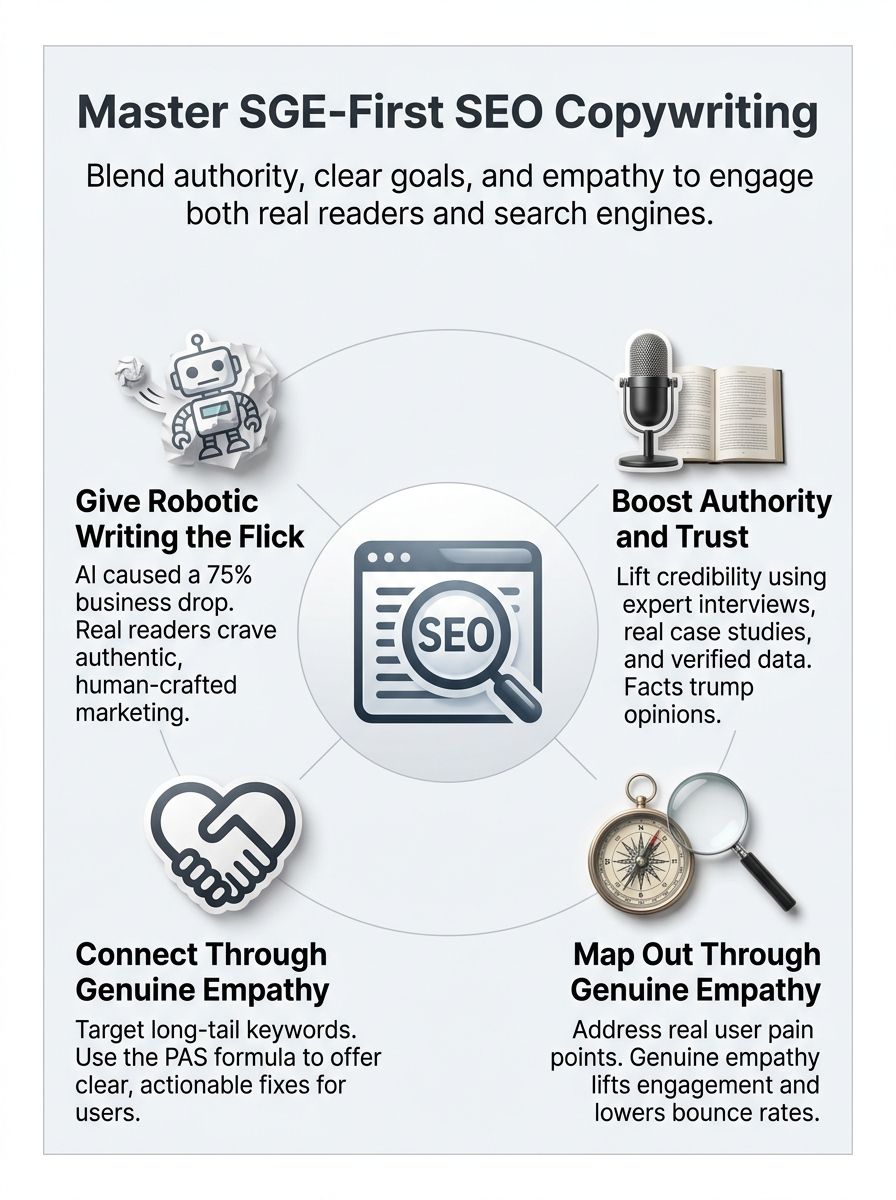
In 2023, I watched my clients experiment with AI-generated copy, and my own business took a 75% hit as a result. People can spot synthetic writing almost instantly, and they want something that actually feels like it was written by a real person who knows their stuff.
That’s what pushed me to dig deeper into SGE-first SEO copywriting, an approach that blends authority, clear goals, and genuine empathy to create content that works for both readers and search engines. And in 2026, with Google’s AI Overviews now appearing in up to 39% of Australian searches according to research by NetStripes and Uprise Digital, getting this right has never mattered more.
I’ve been running Jeff Lee Copywriting since 2010, and over 13 years of working on web content and local SEO for Australian businesses, I’ve learned what actually moves the needle. This guide shares practical techniques for improving your web content, covering everything from title tag optimisation to natural language, so you connect with real people while Google’s algorithms reward you for it.
Grab a coffee and let’s go through it together. I’ll show you what actually works.
Key Takeaways
- SGE-first SEO copywriting blends authority, keyword research, and empathy to meet both user needs and Google’s search ranking standards in 2026.
- AI-generated copy cut business revenue by 75% in 2023, highlighting the demand for authentic, human-focused writing.
- Expert interviews, verified data sources like AnswerThePublic, and strong author bios boost credibility under Google’s E-E-A-T guidelines.
- A 2025 SeoClarity study found that 99.5% of AI Overview sources come from the top 10 organic rankings, making traditional SEO still essential.
- Mapping search intent with tools like Google Trends raises relevance and conversions, especially when using long-tail keywords for local Australian businesses.
Key Principles of SGE-First SEO Copywriting
Great SEO copywriting starts with a clear understanding of keyword research and search intent. Getting these two things right is what separates copy that ranks from copy that just sits there. Tactics like a sharp title tag, a well-crafted meta description, and thoughtful heading structure all play a role in how far your content climbs.
But here’s the bigger picture: Google’s AI Overviews now appear in a significant portion of Australian searches, and a 2025 study by SeoClarity found that 99.5% of AI Overview sources come from the top 10 organic rankings. That means the fundamentals of good SEO still matter enormously. You just need to apply them with more precision and human depth than ever before.
What is Authority and Accuracy (E-A-T) in SEO?
Google cares deeply about authority, accuracy, and trust when it ranks web content. I include expert interviews and real case studies in every SEO article writing project to lift credibility with both readers and search engines.
Kate Toon from The Clever Copywriting School often stresses that a professional SEO copywriter must sound like an industry insider while staying genuinely user-friendly. My work follows this approach by building each section on solid research, verified data, or lived experience, not guesswork.
A well-crafted author bio is far more than window dressing. According to research from sangfroidwebdesign.com.au, in 2026 author bios act as contextual signals for AI-driven search features, helping Google associate content with real people and genuine areas of expertise. Clear authorship helps search systems determine whether your content is worth surfacing or citing.
“Facts don’t have feelings, they simply win.” That’s the rule I live by at Jeff Lee Copywriting. Accuracy trumps opinion every single time.
Google’s E-E-A-T framework, which stands for Experience, Expertise, Authoritativeness, and Trustworthiness, is mentioned 116 times in Google’s Search Quality Rater Guidelines, according to Boostability. That repetition signals how seriously the search engine weighs credibility signals. In 2023, the Helpful Content update made every senior copywriter rethink how they use sources and voice of customer research.
I pull in quotes from subject matter experts or reference tools like AnswerThePublic so each piece earns its place in organic SEO results. The pro-tip I always share with clients: link your author bio to a live social profile, ideally LinkedIn, to give Google a broader picture of your expertise. That consistent presence across the web strengthens your entity trust for AI citation.
How do you create a Goal-Oriented SEO Copywriting Strategy?
Every piece of content I write starts with a clear map of searcher intent. I use SEO tools like Answer the Public and Google Trends to understand exactly what Australians are searching for, and why. Targeting educational, transactional, and investigational searches helps align content with real business goals.
Research from revgenx.com.au confirms that in Australia, search behaviour is strongly action-oriented, and local keywords tend to convert faster because they’re closer to a buying decision. That’s why targeting long-tail keywords with specific local intent, like “SEO copywriter Sydney” rather than just “copywriter,” is such a practical move for Australian businesses. According to Rankmax.com.au, long-tail keywords typically convert better because they signal more specific searcher needs.
A smart SEO strategy covers all three intent stages. Here’s how to think about it:
- Informational (TOFU): Content that answers questions and builds trust early, like this guide.
- Investigational (MOFU): Comparison pages, case studies, and feature breakdowns for people weighing up options.
- Transactional (BOFU): Service pages and landing pages for people ready to act.
Calls-to-action nudge users at every stage of the marketing funnel. Concise H2 headings and bullet points keep information easy to scan, which matters because Google’s AI Overviews favour structured content: around 40-61% of AI Overviews use lists or bullet points, according to research published by evergreen.media.
My favourite technique is the PAS formula from advertising: define a problem, agitate it, then offer a clear fix using persuasive language within each section. The right keyword density, sitting around 0.5% to 1.5% used naturally according to revgenx.com.au, keeps copy readable for both humans and search engines without tipping into stuffed, repetitive territory.
That’s what shifts your Google search rankings in ways you can actually see in your analytics dashboard. Ken Reid and Andy Chatzakis from The Recipe for SEO Success are strong advocates for strategic planning that ties every word back to measurable results. That philosophy is one I’ve carried into every project for over a decade.
How can Empathy and Engagement Improve SEO Copywriting?
Understanding your audience’s pain points creates a deeper connection that lifts time on page and keeps bounce rates low. I weave empathy into each sentence, responding to real user challenges with actionable solutions.
That approach also strengthens the ranking signals that search engine algorithms track. And given that Australian consumers are now leading the world in AI search adoption, with an estimated 12.7 million Australians using AI tools by April 2025 according to webby.net.au, content that genuinely connects with real human questions is the content that gets cited.
Optimised load speed and smart internal linking help visitors feel supported as they explore content development or search for the right SEO tools. Drawing inspiration from experts like Kate Toon, George Giannakeas, and Lachlan Kempson sharpens that message further.
Catchy keywords in title tags and meta descriptions add clarity without fluff. Each piece I write leverages what I call the 5 C’s of engagement:
- Customer Centricity: Start with what the reader needs, not what you want to say.
- Compelling Content: Make every paragraph earn its place on the page.
- Consistency: Build a recognisable voice across every page of your site.
- Clarity: Plain language always outperforms jargon.
- Creativity: A fresh angle makes content worth reading, and worth sharing.
The most overlooked step, in my experience, is writing with enough specificity that AI systems can extract and cite your content. According to roi.com.au, the 2026 content approach that works is: answer the query in the first paragraph, begin each section with a clear topic sentence, and use specific headers that could stand alone. That’s not just good for AI, it’s good for readers too.
Conclusion
SGE-first SEO copywriting puts human needs first. It balances keyword research, empathy, and search intent to keep your content clear, credible, and genuinely engaging.
I rely on smart SEO tools like a keyword generator and a swipe file for sharper title tags and meta descriptions. My focus stays on crafting stories that connect, while also improving Google search rankings in ways that last.
The future of better marketing belongs to creatives who combine real-world insight with the discipline of strong SEO content writing. Write like a human. Think like a strategist. That combination is what Google’s AI wants to cite.
FAQs
1. What does SGE-first SEO copywriting actually look like?
SGE-first SEO copywriting means writing helpful content that directly answers a user’s search intent before worrying about anything else. Since starting Jeff Lee Copywriting in 2010, I have seen this shift from stuffing words to genuinely solving problems for Australian website owners. It puts your reader first and the search engine second for better marketing.
2. How does keyword research change with SGE?
Keyword research now goes far beyond just checking keyword difficulty or plugging terms into a keyword generator. You need to analyse long search strings to truly understand the underlying search intent of your audience. As reported by Uprise Digital in 2026, AI Overviews now appear in up to 39% of Australian search queries, making it critical to figure out exactly what local customers want.
3. Does keyword density still matter for Google search rankings?
Keyword density is no longer the main driver for Google search rankings, especially with generative AI focusing on context rather than repeated words. Search engines now reward clear and helpful seo content writing over pages that just repeat the same phrase endlessly. Focus on natural language instead of hitting a specific percentage to maintain your traffic.
4. How do SEO tools fit into the SGE-first creative process?
Modern seo tools are fantastic for finding gaps in your seo strategy and refining elements like your title tag and meta description. I use them during the creative process to gather data, but I always rely on human insight to write the actual copy. They should act as your guide rather than doing the work for you.
5. Can a junior copywriter handle SGE-first seo content writing?
Yes, a junior copywriter can definitely write strong SGE content if they follow a solid brief and study a good swipe file. They can build their skills quickly by using the Hemingway App to simplify sentences, taking in seo nibbles, and engaging with communities like Clever Copy Chats or LinkedIn. With clear guidance, they can easily master this new approach.
6. What role does a creative director or seo agency play in SGE-first content?
An experienced seo agency or creative director sets the big-picture strategy to ensure every piece of content actually connects with your target audience. They often work alongside a web design company to make sure the user experience matches the high-quality copy, right down to updating your Medium logo or social media. They act as an ad detective to figure out exactly what your competitors are missing so your Australian business can stand out.