

Your website climbs the search rankings, yet visitors still ghost you at checkout.
Your copy reads like it came straight from a template. Traffic pours in, but people bounce faster than you’d like.
That gap between ranking and converting? I’ve watched it trip up Sydney businesses for well over a decade. My team and I started Jeff Lee Copywriting because we kept seeing the same problem repeat itself.
Nearly half of Australians (49%) now use generative AI. That means how people search has shifted from simple keyword hunts to messy, conversational queries.
So what actually works now? I spent months digging into how the best performers rewired their content strategy to bridge this gap.
This piece walks you through how SEO copywriting moved from keyword cramming to genuine conversation. You’ll see why user intent matters more than ever, how AI shapes rankings without killing human creativity, and real tactics to build lasting trust with your audience.
We’ll also cover generative search optimisation, multi-channel content approaches, and how to keep your digital marketing strategy from becoming yesterday’s news.
Your copy can rank. Your copy can convert. Your copy can do both.
Key Takeaways
- SEO copywriting shifted from keyword stuffing to conversational content matching real user intent and search behaviour patterns across Sydney businesses.
- Nearly 49% of Australians now use generative AI, fundamentally changing how people search from simple keywords to natural, conversational queries requiring different optimisation strategies.
- Google’s June 2026 update penalised low-value AI-only content, demanding human expertise, fact-checking, and original perspectives layered over automated drafts for ranking success.
- Multi-channel content integration across blogs, videos, and social media now outperforms single-format pieces in generative search results and user engagement metrics significantly.
- Continuous SEO adaptation through monitoring algorithm updates, user intent alignment, and structured data implementation remains essential for maintaining visibility and conversions in competitive markets.
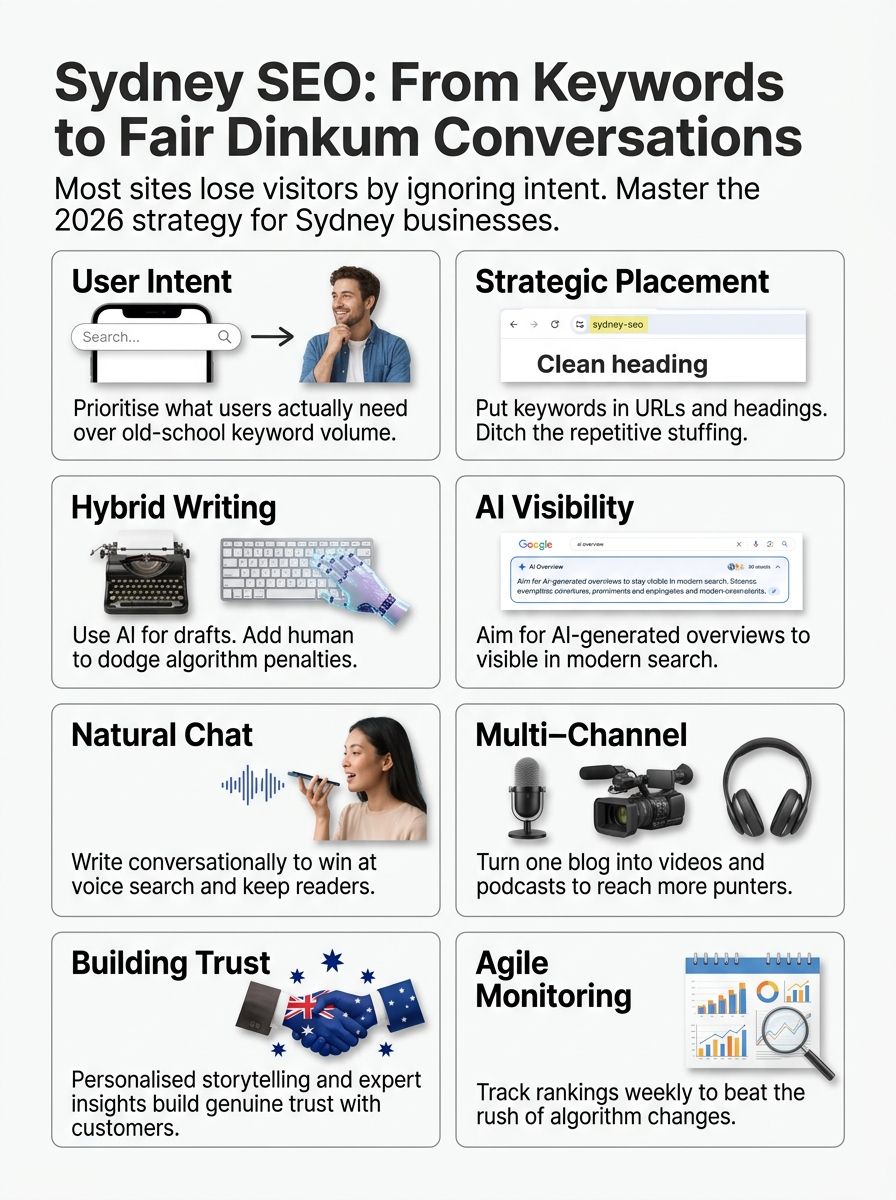
How SEO Copywriting Has Evolved in Sydney
SEO copywriting in Sydney has transformed dramatically since I founded Jeff Lee Copywriting back in 2010. Back then, we stuffed keywords into every corner of web copy. Today, the focus is entirely on content that speaks directly to what your audience actually wants to find.
Search algorithms now reward copy that answers real questions and solves genuine problems. The shift moved from keyword research based purely on search volume to audience targeting that prioritises genuine user intent and meaningful conversations.
What replaced keyword stuffing in SEO copywriting?
I ditched keyword stuffing years ago, and my content strategy improved dramatically. Search engines now penalise excessive or unnatural keyword use, so strategic placement took over.
According to 2026 industry data from MyWork Australia, traditional organic search traffic has declined by 15-25% across industries due to AI answer engines. The flip side is genuinely compelling: traffic driven by conversational AI queries converts up to 6 times higher. Shifting to conversational answers isn’t just about avoiding penalties. It’s about capturing purchase-ready visitors who are actually ready to act.
Keywords now land in critical areas: the URL, title tag, meta description, headings, first 100 words, and image alt text. This approach feels more natural because the focus is on conversational language and quality content rather than rigid keyword repetition.
Quality content with strategic keyword placement beats forced repetition every single time.
One focus keyword per page works best, paired with synonyms and long-tail keywords to boost ranking chances. Title tags stay under 60 characters, whilst meta descriptions sit comfortably under 150 characters, though Google rewrites about 20 per cent of them anyway.
Content length matters far less than topic depth. I’ve ranked 50-word instructions and multi-thousand-word guides equally well. Keyword research still matters because broad or irrelevant terms simply don’t work. Layering in internal linking, rich media, and user-friendly layouts with jump links, whitespace, and subheadings rounds out a strong content strategy.
Writing for actual people first, search engines second, is what changed everything. Organic search results improved once the focus shifted from fighting the algorithm to writing for real user intent.
Why is user and search intent vital for SEO now?
Search intent has transformed how we approach SEO copywriting in Sydney. It falls into four clear categories: informational, navigational, investigational, and transactional.
Your content must address what users actually search for in their moments of need, not just generic search terms. Google’s algorithms like BERT and MUM now prioritise intent and context over exact keyword matches. Based on a 2026 local SEO statistics report by Safari Digital, 46% of all Google searches now include local intent, and mobile “near me” conversational searches have grown by 136% over the past 12 months. For Sydney businesses, that shift is significant.
This means grouping keywords by conversion intent and separating low, mid, and high keenness queries to direct users to the most relevant pages. Content relevance improves dramatically when the copy aligns with what searchers truly want to find.
The customer journey shapes an effective SEO strategy across three distinct stages:
- Top of funnel: The user is problem-aware and searching for general information
- Middle of funnel: They’re solution-aware and weighing up their options
- Bottom of funnel: They’re purchase-ready and need a clear next step
Different messaging works for each stage because a user searching for information differs vastly from one ready to buy. Authority content backed by expertise, authority, and trust now carries more weight than ever before.
Readability standards targeting a Flesch-Kincaid Grade 7-8, with sentences under 16 words, boost user experience and information retrieval. Strong branding and clear contact opportunities on every page build trust and drive conversions. This intentional approach transforms casual browsers into engaged customers ready for the next step.
How AI Is Changing SEO Copywriting

AI tools now reshape how copy gets written for search engines. Machine learning models analyse what people actually search for and help craft responses that match their real intent.
How are AI tools transforming content creation?
AI tools like ChatGPT, Bing AI, and Perplexity have reshaped how clients approach content creation. These platforms now function as essential tools for initial drafts and productivity boosts, cutting research time from hours to minutes.
Yet here’s the catch: Google’s June 2026 update specifically targeted low-value, AI-only content. Every piece still needs expert review layered over the top. A content strategy that works now demands high-quality, in-depth analysis that provides genuine value beyond surface-level summaries.
Schema markup and structured data sit throughout every piece, making the work readable for both search engines and AI-driven platforms. This approach protects against “zero-click” searches that AI tools create when they aggregate information without directing traffic to original sources.
Data analytics show that multimedia integration has become non-negotiable for engagement metrics. According to a 2026 Telsyte Report cited by Undivided Agency, over half of Australian households now own at least one voice-activated device. That means your content needs to sound natural when read aloud by AI tools and smart speakers, not just look polished on a screen. Blending video, infographics, and podcasts alongside written copy meets what both AI systems and real people expect.
The shift toward Generative Engine Optimisation means content must be comprehensive enough to earn AI recommendations across platforms. Treat AI as a starting point, not a finish line.
In what ways do language models influence search results?
Language models like ChatGPT and Google’s MUM fundamentally reshape how search engines rank content. These systems prioritise content structure and context over raw keyword density.
Google’s MUM algorithm favours articles that establish topical authority through comprehensive subject coverage. Search engine algorithms evaluate entity reputation and authority signals, which means your content must demonstrate genuine expertise. According to a 2026 search analysis by Distl, there is a 62% overlap between pages that rank well in traditional Google search and those referenced as citations in ChatGPT answers. That’s genuinely reassuring: your existing SEO work directly feeds into your AI visibility.
Large language models understand semantic relationships between concepts, so stuffing keywords into your copy wastes effort. Clarity and depth beat keyword repetition every single time.
Featured snippets and AI-generated overviews increasingly replace traditional organic results for informational queries, creating what experts call “zero-click searches.” Informational-only sites struggle with declining traffic, whilst commercial queries see increased click-through rates.
Your information retrieval strategy must focus on answering questions thoroughly rather than chasing search terms. User engagement metrics signal quality to language models, so conversational copy that speaks directly to your audience performs better. Topical authority across your entire site influences how algorithms rank each page, making the transition toward semantic search principles a site-wide commitment.
Transition to Conversational SEO
The way I talk to search engines has shifted completely. People now speak in questions and natural phrases rather than cramming keywords into sentences like they’re packing a suitcase.
Search algorithms reward content that matches what people actually want to find. My content performs better because it answers real questions instead of chasing keyword rankings.
How can natural language improve SEO performance?
Natural language processing transforms how search engines understand your content. Instead of chasing keyword density, the focus shifts to what your audience actually wants to find. Search algorithms now prioritise contextual relevance over repetitive phrases, meaning your copy must speak directly to user intent.
Writing conversationally aligns your message with how people search using voice assistants and digital devices. This shift from keyword stuffing to genuine communication creates stronger content alignment that search engines reward with higher rankings.
Conversational language also boosts engagement metrics that search engines track closely. Shorter sentences and accessible readability, targeting Grade 7 to 8 levels, keep visitors on your page longer. Longer time-on-page signals quality to algorithms, which improves your overall visibility.
Content that reads naturally aloud performs better across voice search and digital assistants. By crafting copy that feels like a genuine conversation rather than a marketing pitch, you build trust with your audience whilst simultaneously satisfying search engine requirements. This dual benefit means your website attracts more qualified visitors who actually want what you offer.
What role does semantic search play in modern SEO?
 Semantic search has transformed how search engines like Google understand what people actually mean. Technologies like Knowledge Graph, BERT, and RankBrain now decode the contextual meaning behind words rather than simply matching keywords.
This shift means search engines grasp the relationships between terms and concepts. A query for “best coffee shops near me” retrieves results based on location, user intent, and what “best” means in that specific context.
From working with Sydney-based website owners, I discovered that focusing on query understanding and information retrieval changed everything about how we structure content. Long-tail keywords became gold because they capture conversational queries that reflect how people actually search.
Features like “People Also Ask” and Knowledge Panels now provide quick answers directly on search results pages. That means content needs to address these snippets strategically, not treat them as an afterthought.
Semantic SEO flipped the script on old keyword stuffing tactics. Machine learning and natural language processing work together to analyse how words relate to each other. Content optimisation becomes about alignment with user intent rather than repetition.
Building internal linking structures with contextual design and relevant anchor text improved search relevance dramatically for the Sydney clients I work with. Voice search depends entirely on well-organised semantic structures to match spoken queries with answers.
Knowledge bases that organise information logically rank better because search engines reward content demonstrating genuine topical authority. Traffic increases came when we shifted from targeting isolated keywords to creating comprehensive content clusters that address the full scope of what users need to know.
Strategies for Multi-Channel Content
Spreading your message across multiple platforms demands a completely different approach than writing for a single channel. Audience engagement skyrockets when you adapt your content strategy to fit where your customers actually spend their time.
How do you optimise content for different platforms?
 Platform-specific optimisation transforms how audiences discover and engage with your content. Each channel demands a distinct approach to maximise visibility and drive meaningful interactions.
- Adapt on-page SEO techniques for each platform to boost visibility and engagement across your digital presence.
- Target long-tail keywords for niche platforms or specific audience segments to capture qualified traffic effectively.
- Implement mobile-friendly and responsive design across all channels, since evolving user search behaviours demand seamless experiences.
- Repurpose content from blogs into videos, infographics, or podcasts to save time and expand your reach significantly.
- Track rankings and engagement metrics across platforms to identify which strategies deliver the strongest results.
- Structure your content hierarchy thoughtfully so visitors find information quickly without unnecessary friction.
Conduct focus group feedback sessions to guide platform-specific refinements and test different messaging approaches across your channels. Display brand and contact information prominently on every platform to build trust and drive conversions.
What are the best ways to integrate videos, blogs, and social media?

Optimising content across platforms sets the foundation, but true success comes from weaving those channels together into one cohesive experience. Integration transforms scattered content into a powerful force that drives engagement and search visibility.
- Layer schema markup and structured data across all formats so search engines read videos, blogs, and social posts with clarity. This technical foundation helps Google’s MUM algorithm prioritise rich media for better visibility.
- Repurpose one core piece into multiple formats: convert a blog post into a video, podcast, and infographic to reach different audience segments without doubling your workload.
- Build internal links between your video content, blog articles, and social streams to keep users moving through your ecosystem. Strong linking enhances SEO performance and boosts time on site.
- Apply consistent branding and messaging across every channel so your audience recognises your voice instantly. Uniform tone builds authority and trust with your community.
- Use social media to drive traffic back to your blog and video content through strategic cross-channel promotion. Each platform becomes a gateway to deeper engagement with your brand.
- Track engagement metrics across all channels to identify which content formats resonate most with your audience. Data reveals where your content strategy succeeds and where adjustments matter.
Coordinate posting schedules so your blog launches align with video releases and social media campaigns for maximum impact. Synchronised timing amplifies your message across the entire digital landscape.
The Emergence of Generative SEO

Generative search reshapes how Sydney businesses attract customers through AI-powered content that speaks directly to what people actually search for. Search algorithms have shifted from matching exact phrases to understanding intent, and generative SEO lets you create content that answers questions before customers even ask them.
What are the latest trends in generative search?
Search has fundamentally shifted. AI-powered platforms like Google SGE, Bing AI, and ChatGPT now drive search results in ways that old keyword tactics simply cannot match.
The traditional “10 blue links” format has largely vanished. Instead, AI-generated summaries and recommendations dominate what users see first. This shift matters because featured snippets no longer hold the same power. As highlighted in 2026 search landscape research from Distl, AI Overviews now appear in roughly 13-20% of all search queries, acting as the primary answer before users even see traditional organic links.
Zero-click searches have increased dramatically, meaning users get answers without clicking through to websites. Sydney businesses now compete differently. The focus is on branded searches and authority signals to stay visible.
Content must be comprehensive and high-quality so AI systems can summarise and recommend it effectively.
Multi-format content has become the competitive advantage worth recommending to every website owner. Video, podcasts, and written articles together perform better in generative search results than single-format pieces.
The landscape has changed so much that differentiation is no longer optional. It’s essential for survival. AI recommendations influence customer decisions at critical moments. Brands winning today invest in multiple content types and build genuine authority rather than chasing algorithmic tricks.
Information retrieval now rewards depth, credibility, and user experience across all platforms. Your search engine optimisation strategy must reflect this reality or risk disappearing from the results users actually see.
How can Sydney businesses benefit from generative SEO?

Generative search trends show that AI-driven platforms now select businesses based on relevance, authority, and structured data rather than traditional ranking factors. Sydney businesses can position themselves strategically within these AI systems to capture visibility and leads.
- Focus on schema markup and structured data to increase selection chances by AI tools, which directly impacts online visibility for local search engine optimisation.
- Getting featured in AI-generated “best of” lists drives immediate visibility and qualified leads for Sydney businesses competing in digital marketing spaces.
- Geo strategies help smaller businesses compete against larger brands by building topical authority and relevance within specific market segments.
- Implement multi-channel content strategies across blogs, videos, and social media to amplify reach and reinforce brand authority across platforms.
- Authentic storytelling and genuine expert knowledge improve engagement rates on AI-driven platforms, which search engines reward with better placement.
- Track click-through rates, engagement metrics, and backlinks to measure generative SEO effectiveness and adjust your competitive analysis accordingly.
Continuous market adaptation keeps your approach agile, allowing quick responses to evolving search behaviours and emerging generative trends. Prioritising audience engagement through personalised copy builds trust, making your business more likely to appear in generative search results.
Crafting Human-Centred Content
Blending AI-generated content with an authentic human voice builds genuine connections with your audience. Personalised copy transforms strangers into loyal followers because people respond to messages that speak directly to their needs and values.
How to blend AI-generated content with authentic human voice?
I start with AI-generated drafts as a foundation, then layer in marketing expertise and real-world storytelling to create something genuinely valuable. Tools like ChatGPT excel at productivity and drafting, but they cannot replicate the personal insights that come from years working in communications.
Reading content aloud catches awkward phrasing and ensures the tone feels natural, not robotic. Subject matter knowledge transforms a generic AI outline into something with real authority.
Injecting specific examples from real campaigns, client wins, and lessons learned is how you sidestep the June 2026 algorithm penalty that targeted sites relying solely on AI-generated copy without human value added.
Originality matters more now than ever before. A practical tip I always share with clients: verify that AI-assisted drafts aren’t just regurgitated content by checking against competitor pieces and your own previous work. Personalisation comes through when you weave in storytelling that only you can tell, whether that’s a failed experiment or a breakthrough moment.
Trustworthiness builds when readers sense expertise and engagement in every paragraph. A final oversight pass catches errors, tonal mismatches, and opportunities to strengthen readability.
This blend of artificial intelligence and authentic human voice positions Sydney businesses to rank well and actually connect with their audiences. Multi-format content across videos, blogs, and social platforms amplifies this human-centred approach even further.
How does personalised copy build trust with audiences?
Crafting content that speaks directly to what your customers actually need, rather than what generic templates suggest, is where trust begins. Audiences detect insincerity faster than you’d think.
Personalised copy addresses real-world scenarios your visitors face daily. A customer managing inventory challenges doesn’t need vague business advice. They need solutions that fit their operation.
Including specific contact opportunities and strong branding on every page is where credibility lives. Content shaped around the customer journey, whether someone sits at the top, middle, or bottom of your funnel, increases relevance dramatically.
Returning users, longer session durations, shares, and comments all signal that your audience trusts what they’re reading.
Authentic storytelling combined with expert knowledge builds loyalty that lasts years, not weeks. Weaving genuine reviews and user feedback into your content carries weight that polished marketing speak never does.
Consistency in voice and messaging across your platforms reinforces brand reliability. Your audience knows what to expect from you. Personalised copy also attracts backlinks and positive engagement signals naturally because people share content that resonates with their specific situations.
Trust isn’t something you manufacture. It emerges when your copy demonstrates that you understand your reader’s world. This foundation of trustworthiness sets the stage for how semantic search and natural language patterns shape the way modern audiences discover and interact with your content.
Future-Proof Your SEO Approach
I adapt my SEO strategies constantly because search algorithms shift faster than Sydney traffic during rush hour. Your website traffic depends on staying ahead of these changes, not falling behind them.
How can you adapt to evolving search behaviours?
Search behaviours shift faster than most website owners realise, and staying ahead requires constant vigilance. Adaptation isn’t a one-time fix. It’s an ongoing commitment to understanding what your audience actually wants.
- Track ranking changes weekly using SEO tools to spot shifts in search patterns before competitors do. Performance metrics reveal which strategies work and which ones fall flat.
- Mobile responsiveness isn’t optional anymore. Zero-click searches dominate user behaviour, so optimise every page for smaller screens and fast load times.
- Structure content with summaries and tables of contents because users seek quick answers. Featured snippets capture attention when searchers want information without clicking through.
- Monitor algorithm updates like BERT and MUM closely. Content organisation must align with these shifts to maintain visibility.
- Let user intent drive everything you create, replacing old keyword-stuffing tactics that no longer work. Aligning copy with what searchers actually need keeps engagement high.
- Test different content formats on various platforms, from blogs to videos to social media. Multi-channel approaches capture audiences wherever they search.
The shift toward conversational SEO means blending human authenticity with strategic optimisation to build lasting trust.
Why is continuous SEO improvement essential?
Adapting to evolving search behaviours means committing to ongoing optimisation work. Google’s June 2026 update demonstrates how rapidly algorithm changes can reshape website rankings and online visibility.
Stop improving your content strategy, and your digital marketing efforts lose momentum against market competition. The search engine optimisation landscape shifts constantly, so treat SEO as a continuous cycle rather than a finished project.
Traffic, engagement, and conversions require regular monitoring and adjustment to maintain authority in Sydney’s competitive digital market.
Regular updates and improvements capture new opportunities before competitors do. Voice search, AI tools, and emerging platforms create fresh pathways for user engagement that didn’t exist last year.
Web analytics reveal which content performs well and which needs refreshing. That data guides your next moves. Staying current with algorithm updates and content formats protects your rankings whilst maximising reach across multiple channels.
Continuous skill development through industry training keeps your approach sharp and effective, ensuring you remain visible when potential customers search for your services.
Conclusion
Sydney’s SEO landscape has transformed dramatically, shifting from rigid keyword stuffing to genuine conversations that actually matter. The businesses thriving right now prioritised user engagement and search intent rather than gaming algorithms.
Your content strategy must blend AI-driven tools with an authentic human voice, creating copy that speaks to real people whilst satisfying search engines. The future belongs to those who master multi-channel content optimisation and stay responsive to algorithm shifts.
Start building your conversational SEO approach today. The businesses winning in 2026 stopped chasing keywords and started solving customer problems.
FAQs
1. How has SEO copywriting changed in Sydney by 2026?
I’ve watched SEO copywriting shift from keyword stuffing to writing content that feels like a real conversation. From my 13 years working with Sydney businesses, I can tell you that Google’s algorithms now prioritise search intent over keyword density, which means readers and search engines both reward copy that genuinely answers questions.
2. Why does conversational content rank better now?
Google’s natural language processing technology, including updates like BERT and MUM, now reads context, tone, and meaning instead of just counting repeated phrases.
3. Do Sydney copywriters still do keyword research?
Yes, I still do keyword research for every project, but I weave terms naturally into copy that speaks directly to your readers. It’s less about hitting a target number and more about sounding like a real human.
4. What should Sydney businesses look for in an SEO copywriter today?
Look for someone who understands search intent, writes in a clear and direct voice, and knows how to turn a search query into genuine conversation. I’ve found that technical SEO knowledge matters, but so does the ability to connect with real people through words.