

So you’ve checked your website stats and thought, “Hang on…We’ve got visitors, so why aren’t more people calling or enquiring?”
That’s the gap an SEO copywriter helps close, we write pages that earn visibility in search results and give readers a clear reason to take the next step.
Many websites attract traffic but miss the chance to turn visitors into customers.
Good SEO copy can lift organic traffic and improve search engine rankings with smart keyword research, tidy on-page SEO, and words that match real buyer behaviour.
We started Jeff Lee Copywriting in Australia in 2010, and we’ve kept sharpening our local SEO approach ever since.
We write website copy, meta descriptions, landing pages and blog posts that match brand tone and user intent, then we help guide crawlers to the right pages.
It matters to us that your words work as hard as the rest of your business, so you can turn attention into action.
Keep reading and we’ll walk you through what an SEO copywriter does, and the practical steps you can use straight away.
What is an SEO copywriter?
An SEO copywriter creates clear, persuasive copy for pages that matter to your business, and we make it easier for search engines to understand those pages.
That means writing and improving website copy that’s built to convert, plus SEO content for blog posts, landing pages, product descriptions and case studies.
We also handle the “invisible” bits that influence clicks and understanding, like title tags, headings, meta descriptions, alt texts, and clean, readable URL slugs.
What SEO copywriting actually changes on your site
- What you rank for: we align each page to a clear set of keyword phrases and a specific search intent, so Google knows when to show it.
- What people click: we shape titles and meta descriptions to match what searchers want, so your listing looks like the best option.
- What people do next: we write calls to action that feel natural, so the page earns enquiries, bookings, or sales.
- How easy the page is to use: we structure content for scanning on mobile, with short paragraphs, strong headings, and clear next steps.
- How consistent your brand feels: we protect brand messaging across every page, so your site sounds like one confident business.
Meta descriptions, snippets, and why Google might rewrite your message
Here’s a detail many website owners miss: Google often creates snippets automatically from on-page content, and it may use your meta description when it better explains the page for a specific query (as outlined in Google’s snippet documentation).
That’s why we treat meta descriptions like a mini pitch, but we also make sure the first screen of the page delivers the same promise.
- We keep descriptions specific: each important page gets its own summary, not a copied template.
- We pull in decision details: services, service areas, key inclusions, or what happens next.
- We avoid keyword stuffing: long strings of keywords can hurt readability, and they’re less likely to show as your snippet.
- We use snippet controls when needed: for sensitive pages, we can work with your developer to use options like snippet limits or exclusions.
Next, we’ll break down the main duties of an SEO copywriter, and what those duties look like in the real world.
Main duties of an SEO copywriter
Our job sits in the middle of search engine optimisation and conversion copywriting.
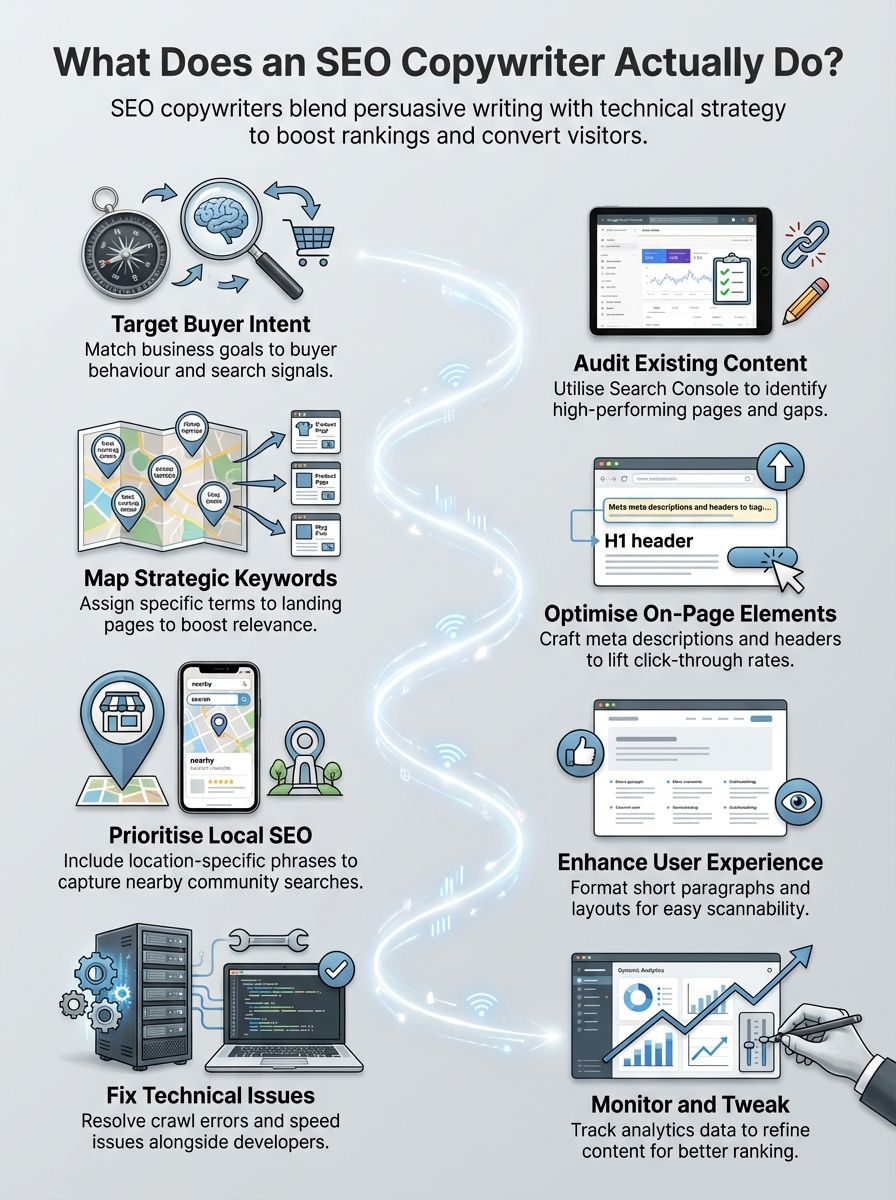
We do keyword research, map terms to the right pages, write in a way that supports search engines and humans, and then track metrics so the content keeps improving.
1) Conduct keyword research and build a keyword-to-page map
We start keyword research with business goals, because “more traffic” only helps if it’s the right traffic.
Then we match those goals to buyer behaviour and queries we can realistically win.
- Define your target audience: what they want, what they fear, and what they need to decide.
- Audit what you already have: we check existing website copy and performance in Search Console and Keyword Planner to find quick wins.
- Collect keyword ideas: we use tools like Ahrefs, SEMrush and the planner to pull volume, difficulty, and related searches.
- Sort by intent: informational phrases suit blog posts, while transactional phrases belong on landing pages and product descriptions.
- Map keywords to pages: one page, one primary topic, so pages don’t compete with each other.
- Plan supporting content: we build blog posts and FAQs that feed authority into your key landing pages.
2) Create optimised content that’s easy to read and easy to act on
We write copy that ranks and converts, without making it feel robotic.
To do that, we blend content marketing structure with persuasion, then polish the on-page SEO details that help search engines understand the page.
- We use Google Analytics and Google Search Console to spot search trends, traffic gaps and high-value queries, then match them to the right page type.
- We write headings that guide the reader, using simple language and clear layout so people can scan and still get the point.
- We strengthen internal linking suggestions so crawlers and readers can move naturally from general info to your money pages.
- We add practical conversion cues, like trust signals, proof points, and clear calls to action placed where people are ready to decide.
- We optimise images for accessibility and context, including useful alt tag text that describes the image in plain language (which also helps Google understand the image).
3) Improve titles and click-through rates (without gimmicks)
A title link is often the first impression your business makes in search results.
Google’s guidance on title links is clear: use descriptive, concise titles, avoid vague labels like “Home”, and make sure every page has a proper title in the page’s title element.
- Lead with clarity: we name the service or topic and who it’s for.
- Match the page: we avoid clickbait that makes people bounce.
- Make titles distinct: each page earns its own angle, so Google has fewer reasons to rewrite them.
- Use natural keyword prominence: we include key terms where they help understanding, not as filler.
4) Support local SEO with location-specific copy and profile consistency
Local SEO is where a lot of Australian businesses can win fast, because it lines up with real “near me” demand.
If you serve customers across suburbs, your site should make that clear in a helpful way, not by repeating suburb names endlessly.
Local SEO works best when your service pages answer the questions locals actually ask, and your details stay consistent everywhere.
- Service area pages: we create pages that explain how you help customers in a specific area, with local examples and FAQs.
- Consistent NAP details: we keep your name, address and phone consistent across your site and listings to reduce trust issues.
- Google Business Profile alignment: Google Business Profile Help notes you can set up to 20 service areas, and approved edits can take up to 48 hours to show.
- Review-ready wording: we add prompts that make it easy for happy customers to leave specific feedback.
5) Work with developers and designers on technical SEO and UX
We’re not your developer, but we do work closely with developers and web designers, because copy and layout affect speed, usability, and conversion.
This is where “good writing” meets page experience.
Google’s Core Web Vitals targets give practical benchmarks for user experience, and they’re measured using field data at the 75th percentile of visits. Google also confirmed that INP replaced FID as a Core Web Vital on 12 March 2024.
| Metric | What it measures | Good target | Copy and page actions that help |
|---|---|---|---|
| LCP | How fast the main content appears | 2.5 seconds or less | Keep hero sections lightweight, compress images, and avoid massive above-the-fold sliders. |
| INP | How responsive the page feels during interactions | 200 ms or less | Be careful with heavy widgets, pop-ups, and third-party scripts that block interaction. |
| CLS | How stable the layout is while loading | 0.1 or less | Reserve space for images and embeds, and avoid late-loading elements that push content down. |
6) Monitor results and refresh pages so they keep earning
SEO copywriting is not “publish and pray”.
We pull performance data, make small targeted edits, and keep what’s working.
- Search Console: we review clicks, impressions, click-through rates, and which queries trigger each page.
- Analytics: we check engagement and conversion paths, then tighten copy where users drop off.
- Testing: we A/B test headlines and calls to action on key landing pages when you have enough traffic to learn from it.
- Content updates: we refresh blog posts and service pages when offers change, services expand, or the SERP intent shifts.
What skills are essential for an SEO copywriter?
To do SEO copywriting well, we need writing skills, editing discipline, keyword research know-how, and a practical feel for how users move through a page.
We also need enough technical SEO awareness to work smoothly with your developer and keep the user experience (UX) strong.
Writing and editing that respects your brand and your reader
Strong writing keeps your message clear, and strong editing removes the fluff that makes people leave.
In our experience, the fastest wins often come from tightening the offer, sharpening the first paragraphs, and making the next step obvious.
- Plain English structure: short paragraphs, helpful headings, and fewer “marketingy” sentences.
- Persuasion: benefits, proof, and a call to action that suits your service and your audience.
- Consistency: one voice across website copy, blog posts, landing pages, and product descriptions.
- Original content: fresh examples and clear explanations, so your site earns trust.
SEO best practices that are practical, not theoretical
We apply SEO best practices in a way that supports humans first, because the goal is a better result for the reader and the business.
- We research keyword phrases with keyword research tools and user intent in mind, so you target terms that suit your actual offer.
- We improve on-page SEO with better headings, clearer topic focus, and sensible keyword prominence, without forcing awkward repetition.
- We use meta descriptions strategically, knowing Google may rewrite snippets depending on the query.
- We plan internal links that guide crawlers and help users find the next helpful page.
- We keep accessibility in mind, especially for image alt text and readable layouts.
Analytics confidence, so improvements are not guesswork
Data helps us decide what to change, and what to leave alone.
We look for patterns, then make one meaningful improvement at a time.
- Low click-through rate: we adjust titles and meta descriptions to better match the query.
- High bounce rate: we tighten the opening, add clearer answers, and improve scannability.
- Good traffic but low conversions: we strengthen trust signals, proof, and calls to action.
- Ranking decline: we update content to match current intent and improve completeness.
Tool fluency and collaboration
We use marketing tools to speed up research and measure results, but we still rely on judgement and careful editing.
| Tool or capability | What we use it for | Why it matters to a website owner |
|---|---|---|
| Google Analytics | Engagement and conversion tracking | You can see if copy changes lead to more enquiries, not just more visits. |
| Google Search Console | Queries, pages, impressions, and click-through rates | You learn what you already rank for, then build content optimisation around real demand. |
| Ahrefs and SEMrush | Keyword research, competitor analysis, and gap finding | You stop guessing and start targeting the phrases that can actually move revenue. |
| Google Docs | Drafting, reviews, and version control | You get clean approvals and faster publishing with fewer mix-ups. |
| ChatGPT (used carefully) | Idea generation, outlines, and draft support | You get speed without sacrificing brand tone or originality, because we still edit and verify. |
How to choose an SEO copywriter for your website
If you’re hiring, you want more than “nice writing”.
You want a process that protects your brand, makes SEO measurable, and helps your site earn leads.
A quick hiring checklist (what we’d ask if we were in your shoes)
- Ask for a keyword-to-page plan: a good SEO copywriter should explain which pages target which queries, and why.
- Look for people-first thinking: Google’s guidance updated in December 2025 encourages creators to assess content through “Who, How, and Why”. Your writer should be able to talk through that in plain language.
- Confirm what’s included: titles, meta descriptions, headings, internal links, and basic alt text guidance should be part of the scope for key pages.
- Check measurement: your writer should be comfortable reviewing Search Console and analytics, then recommending specific improvements.
- Expect collaboration: the best results happen when copy, design, and technical SEO support each other.
What a good SEO copywriting handover looks like
We aim to leave you with something your team can publish confidently.
- A clear draft for each page (with headings, calls to action, and layout notes).
- Suggested title tags and meta descriptions for priority pages.
- A simple internal linking plan that supports your main landing pages.
- Notes for images, including where alt text needs to describe context, not just repeat keywords.
Conclusion
An SEO copywriter writes web pages, blog posts and landing pages that earn visibility and turn that visibility into action.
Keyword research shapes page focus, on-page SEO supports crawlers, and meta descriptions help listings win clicks in search results.
We track organic traffic and key metrics, then refine titles, headings, and calls to action so your site keeps improving.
For Australian businesses, local SEO and clear brand messaging can make the difference between “just visits” and real enquiries.
FAQs
1. What does an SEO copywriter do?
An seo copywriter writes website copy and seo content that speaks to people and search engines. They use seo copywriting, writing skills and digital marketing know how to lift brand messaging.
2. How do they use keyword research and keyword phrases?
They run keyword research to find useful keyword phrases. They watch keyword density and keyword prominence when they do content optimisation and on-page seo.
3. Do they write meta descriptions, landing pages and blog posts?
Yes, they craft meta descriptions and meta description lines, landing pages, blog posts, product descriptions and case studies. Each piece aims to help search engine optimisation and bring organic traffic.
4. How do they help search engine rankings and organic traffic?
They follow seo best practices and the google algorithm, and they work with technical seo to fix barriers. That boosts search engine rankings and brings steady organic traffic.
5. What other skills do they need?
They use user experience (ux) sense, persuasion and active listening to match readers. They link content marketing, social media and the web, so the copy fits the internet and what marketers want.
6. How do they work with an seo specialist or other teams?
An seo copywriter teams up with an seo specialist to thread strategy into real copy. Not to be confused with the typo seo copywriteri, they add writing skills, seo content craft and practical know how to the project.