

Your Sydney business might be invisible online. Customers search for services in their local area, but your website doesn’t appear in their results. This frustration costs you potential clients every day.
I faced this exact challenge when helping local businesses improve their online visibility. Billions of local searches happen monthly, yet many Sydney businesses miss these golden opportunities.
Through years of research and testing, I’ve developed a proven system for local SEO copywriting that works specifically for Australian markets.
This guide will show you how to write content that attracts local customers and boosts your search rankings. You’ll learn practical steps to target Sydney suburbs, craft compelling copy, and optimise every element of your website for local search.
Your competition won’t know what hit them.
Key Takeaways
- Sydney businesses need suburb-specific keywords like “emergency plumber Surry Hills” rather than generic terms to capture qualified local leads effectively.
- 76% of smartphone local searches result in business visits within 24 hours, making mobile-friendly design crucial for Sydney customer conversions.
- LocalBusiness schema markup with accurate NAP details helps search engines understand your Sydney location and improves local search rankings.
- Four search intent types drive local searches: informational, navigational, commercial, and transactional, requiring tailored content strategies for each type.
- Mobile sites loading in 1 second convert 2.5x more than those loading in 5 seconds for local Sydney businesses.
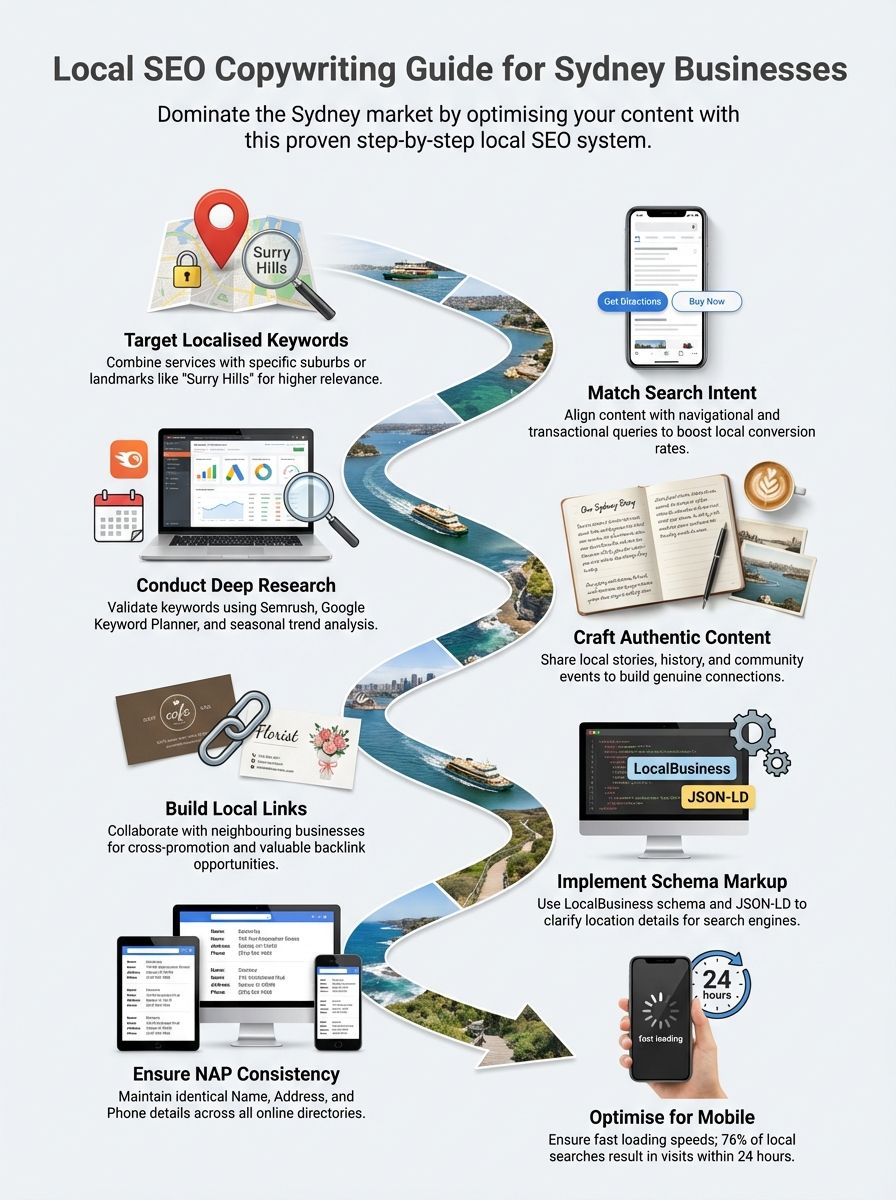
Understanding Local SEO Copywriting for Sydney Businesses
Local SEO copywriting in Sydney requires a different approach than general SEO writing. You need to speak the language of your local customers while targeting specific suburbs and regions across this sprawling harbour city.
What Sydney-specific keywords should I use for local SEO?
I recommend focusing on localised keywords that combine your service with “Sydney” to capture relevant searches. Terms like “Sydney cafes” or “Sydney roof repairs” work brilliantly for improving visibility.
Suburb-specific keywords pack even more punch. Think “emergency plumber in Surry Hills” or “Bondi Beach activities” for your target areas. These long-tail keywords convert better because they attract people ready to buy.
Neighbourhood names become your secret weapon for attracting qualified leads. Incorporate suburbs like “Surry Hills coffee shops,” “Inner West renovations,” or “Northern Beaches maintenance” into your content strategy.
Popular landmarks and colloquial phrases that Sydney residents use daily add authentic local flavour. Seasonal trends matter too. “Outdoor furniture Sydney” peaks before summer, while “Eastern Suburbs real estate” stays consistent year-round.
Track performance regularly and adapt your approach to stay competitive in the Sydney market.
How can I target local search intent effectively?
Finding the right Sydney-specific keywords sets the foundation, but targeting local search intent effectively takes your strategy to the next level. Google displays local results even without explicit location keywords, thanks to user location detection, which means your content must align with what searchers actually want.
Four search intent types drive local searches: informational, navigational, commercial, and transactional. Tom Capper from Moz highlights that Google shows a local pack for transactional queries, making this understanding crucial for businesses.
For navigational searches like “Pizza Hut,” complete your Google Business Profile with directions, descriptions, and e-commerce features. Not all local searches have transactional intent, so use Moz Pro’s Search Intent feature to categorise keywords accurately.
Tailoring website and Google Business Profile content to match search intent increases both engagement and conversion rates while building authentic local content that improves customer trust and local pack rankings.
Step-by-Step Guide to Local SEO Copywriting
Creating effective local SEO copy for Sydney businesses requires a systematic approach that combines targeted keyword research with location-specific content strategies. I’ll walk you through each essential step that transforms your website from invisible to irresistible for local Sydney customers.
How do I conduct local keyword research?
Local keyword research forms the backbone of successful Sydney business visibility online. I’ve spent years helping businesses crack this code, and the process breaks down into manageable steps.
- Start by brainstorming potential keywords that combine your services with Sydney-specific terms like “digital marketing agency Sydney” or “plumbing services Bondi”. Write down every combination that comes to mind.
- Use Semrush’s Keyword Magic Tool to validate your initial keyword list and discover new geotargeted keywords you might have missed. This tool reveals search volumes and competition levels.
- Check Google Keyword Planner for additional Sydney-focused terms and their monthly search data. The platform shows exactly what locals type into search bars.
- Examine Google Trends to spot seasonal patterns in your location-based marketing keywords. Some terms peak during specific months or events.
- Research both explicit searches like “IT support services in Sydney” and implicit ones such as “hair salons near me”. Both types drive local traffic differently.
- Track local metrics for each keyword, including search volume, competition, and cost-per-click data. These numbers guide your priority decisions.
- Conduct separate research for each suburb you serve because search behaviours vary dramatically between Manly and Parramatta. Each area has distinct search patterns.
- Map validated keywords to specific web pages on your site. Match commercial keywords to service pages and informational terms to blog posts.
- Test proximity searches by searching your keywords from different Sydney locations. Results change based on the searcher’s physical location.
- Monitor your chosen keywords monthly using tracking tools. Local search trends shift faster than national ones, requiring regular updates.
How can I create location-focused and engaging content?
Creating location-focused content that resonates with Sydney audiences requires authentic storytelling and genuine community connection. I’ve discovered that successful content goes beyond stuffing keywords into generic text.
- Write about Sydney events, fundraisers, and community partnerships to showcase your business as a trusted authority rather than just another service provider seeking attention.
- Share fascinating stories about Sydney’s rich history or invite customers to share their own memories, as nostalgia marketing significantly boosts community engagement levels.
- Craft authentic content that reflects real Sydney experiences and evokes genuine emotions, following Crystal Carter’s emphasis on authenticity over manufactured messaging.
- Develop informative web pages about industry news, comprehensive area guides, or detailed event calendars that position your business as an invaluable community resource.
- Weave location keywords naturally throughout your content while maintaining smooth readability, avoiding forced or awkward keyword placement that disrupts the flow.
- Add practical value through interactive maps, detailed suburb guides, or helpful resources that serve both user needs and strengthen your SEO performance.
- Collaborate with fellow Sydney businesses on co-authored content pieces or conduct interviews, generating valuable backlinks while creating meaningful cross-promotion opportunities.
- Focus on emotionally resonant content that drives higher engagement rates and builds lasting trust among your target audience members.
Optimising On-Page Elements for Sydney SEO
Getting your Sydney business to rank locally means fine-tuning every element on your website pages. I’ll show you how metadata and mobile design work together to boost your local search presence across Sydney’s competitive market.
How do metadata and schema improve local relevance?
Metadata and schema markup work like a GPS system for search engines, helping them understand your Sydney business location and services with crystal clarity. Through my 13 years of copywriting experience, I’ve watched businesses transform their local search visibility by implementing LocalBusiness schema with accurate geographic details, including their address, ABN, and trading hours.
JSON-LD format makes this process straightforward, and Google’s Rich Results Test validates your implementation perfectly.
Schema markup creates structured data that improves crawlability and indexing, which directly impacts your appearance in Sydney-local search results. NAP consistency across directories, schema, and on-page content establishes legitimacy with Google’s algorithms.
Product and FAQ schema further refine content relevance for local Sydney searches, while Organisation and Place schema provide comprehensive coverage that search engines love.
Why is mobile-friendly design important for local users?
While metadata and schema markup help search engines understand your content, mobile-friendly design directly impacts how local customers interact with your business. Mobile compatibility has become the backbone of local business visibility, especially for Sydney companies competing in today’s fast-paced market.
Statistics paint a clear picture: 76% of smartphone local searches result in a business visit within 24 hours, and 28% lead to purchases. Your mobile site performance can make or break these conversions.
E-commerce sites loading in 1 second convert 2.5x more than those loading in 5 seconds. Local customers expect lightning-fast access to business hours, directions, and contact details.
In fact, 54% of smartphone users search for business hours, while 53% look for directions. Poor mobile usability kills these opportunities before they start. Google Maps searches for “shopping near me” have increased over 100% yearly globally, proving mobile search queries drive local foot traffic.
A mobile-friendly website must load in under 3 seconds and pass Google’s Mobile-Friendly Test to compete effectively. Responsive web design with clear navigation, readable text, and properly spaced links creates positive user experience for Sydney customers.
Poor mobile optimisation leads to devastating results: 68% of consumers abandon businesses with incorrect or inaccessible online listings.
Conclusion
Local SEO copywriting transforms Sydney businesses from invisible to irresistible. Smart business owners who implement these step-by-step strategies will dominate local search results and attract more customers.
My experience shows that consistent application of local keyword research, Google My Business optimization, and suburb-level targeting delivers real results. Start with one suburb, perfect your approach, then expand across Sydney.
Your local customers are searching right now, so make sure they find you first.
FAQs
1. What makes local SEO copywriting different for Sydney businesses?
Local SEO copywriting targets Sydney customers specifically. You write content that mentions local suburbs, landmarks, and community events. This helps Google connect your business with people searching in your area.
2. How do I start writing SEO copy for my Sydney business?
Begin with keyword research focused on your Sydney location. Find terms like “plumber Bondi” or “cafe Surry Hills” that locals actually search for.
3. Should I mention specific Sydney suburbs in my website copy?
Absolutely! Drop suburb names naturally into your content. Write about serving Paddington, Newtown, or Manly if that’s where your customers live. Google loves this local connection.
4. How often should I update my local SEO content?
Update your content monthly with fresh local information. Add new suburb pages, mention local events, or write about seasonal trends affecting Sydney businesses. Fresh content keeps you visible in local searches.