

Have you ever felt like you’re doing everything right with your website, yet Sydney customers still aren’t finding you online?
I get it. You’re putting in the work, but something’s missing.
The truth is, most Sydney business owners make a handful of small SEO copywriting mistakes that can cost them big. I’m talking about things like cramming too many keywords into one paragraph, ignoring how people actually search for local businesses, or forgetting that half your visitors are on their phones.
I started Jeff Lee Copywriting back in 2010 with one simple goal: help local businesses get found through smart content strategy. After 13 years working on SEO projects across Australia, I’ve seen just about every copywriting mistake there is.
Some of these errors can push your website down in Google’s rankings faster than you’d think.
Let me share what I’ve learned so you can fix these issues before they hurt your business.
Key Takeaways
- Keyword stuffing triggers Google penalties and drops your rankings overnight, with experts like Matt Cutts and John Mueller warning against this practice since it harms both user engagement and content quality.
- Completing your Google Business Profile can lift local visits by up to 70%, with a 32% better chance of ranking in Sydney’s competitive local search results.
- Thin or duplicate content from technical issues dilutes your site’s authority, affecting up to 30% of websites due to CMS problems and poor URL structure.
- Missing or weak meta descriptions can reduce click-through rates by 10-15% for Sydney websites, while unclear heading structures confuse both visitors and search engines.
- Strong internal linking with descriptive anchor text boosts site authority, with Google’s John Mueller calling them “crucial for SEO” since they guide both users and search bots through your content.
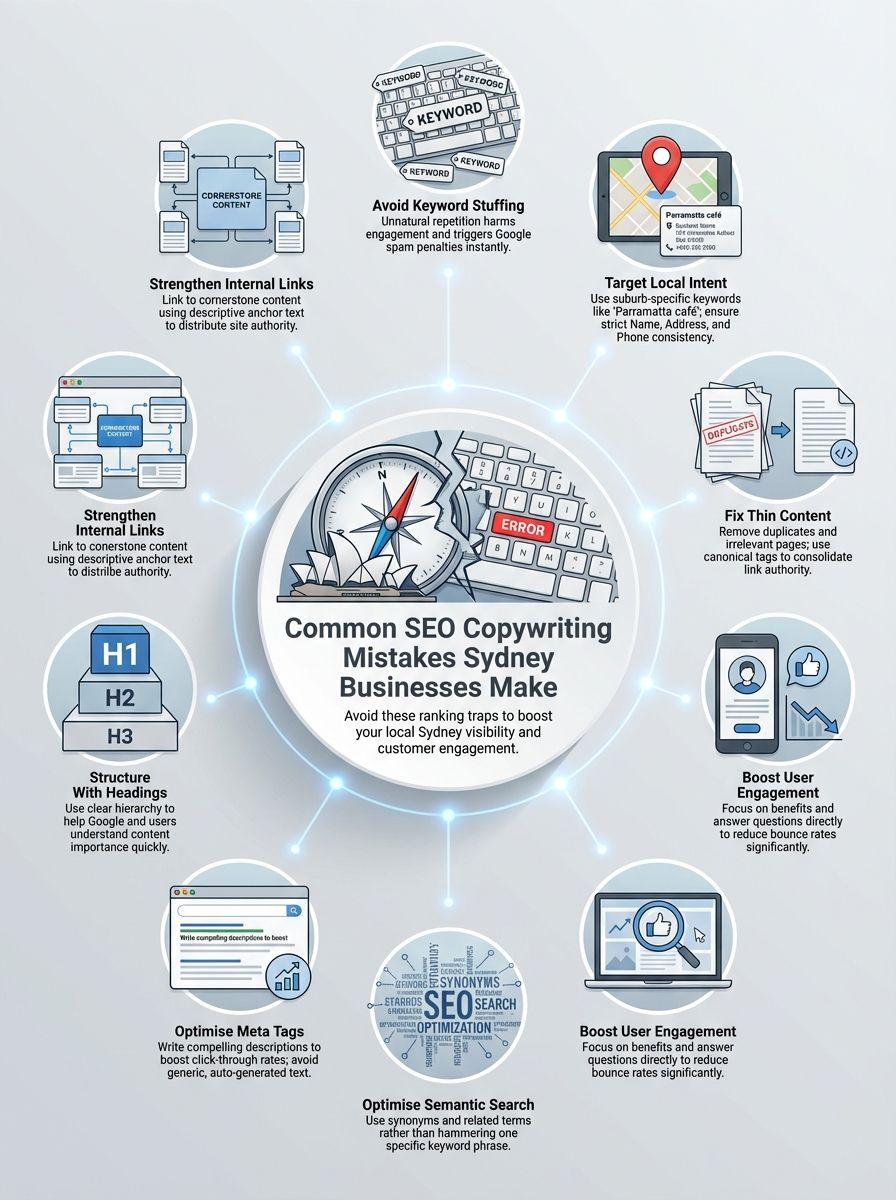
Common Keyword Mistakes in SEO Copywriting
Sydney businesses fall into predictable keyword traps. These mistakes can tank your search rankings faster than you’d expect.
Let me walk you through the two biggest problems I see.
What is keyword stuffing and why should it be avoided?
Keyword stuffing means loading your pages with the same phrase over and over, like “plumber Sydney” appearing five times in one paragraph.
You’re trying to game Google, but it doesn’t work anymore.
Google’s spam policies flag this behaviour immediately. According to a 2026 industry analysis, Google makes over 4,500 improvements to its algorithm each year, and many target manipulative keyword tactics. Both Matt Cutts and John Mueller have warned against keyword stuffing because it harms user experience and signals poor natural language processing to search engines.
I’ve watched websites drop their rankings overnight after stuffing keywords unnaturally. Readers bounce quickly when they hit awkward, repetitive text. The content feels robotic, not helpful.
Here’s what works better: use your main keyword naturally, then sprinkle in related terms.
Think about how real people search. They might type “emergency plumber Bondi” or “fix burst pipe Sydney.” Using semantic variations makes your content more readable and helps you rank for multiple related searches.
Strategic keyword density beats keyword dumping every single time.
How can I optimise content for local search intent in Sydney?
Sydney’s local SEO needs a sharp, focused approach because competition is fierce.
I always add suburb-specific references. Using location keywords like “cafe Parramatta” or “SEO agency Bondi” helps me catch the 46% of Australian Google searches that carry local intent.
Your Google Business Profile is critical. Completing every field lifts your ranking chance by about 32%. A complete profile can increase visits by up to 70%, according to 2026 local SEO data from Australian agencies.
I make sure Name, Address, and Phone (NAP) match everywhere online. This consistency builds trust with both users and Google.
Local citations matter too. List your business on trusted directories.
Mobile optimisation is non-negotiable. In 2026, Australia’s smartphone penetration sits around 87%, with over 26 million internet users online. Most local searches happen on phones, so your site must load fast and look good on small screens.
Reviews work magic. They build trust fast and help your standing in suburb-based results. According to 2026 research, 80% of users read the first ten reviews before choosing a business.
Quality matters as much as location. Next, I’ll focus on writing SEO copy that keeps readers interested without losing sight of user experience.
Content Quality Issues
Weak content drags your Sydney business down in search rankings. Strong copywriting and clear messaging boost audience engagement and website traffic.
Let me show you what to avoid and what to aim for.
What problems do thin, duplicate, or irrelevant content cause?
Thin, duplicate, or irrelevant content wrecks your website’s performance.
Search engines like Google struggle to index these pages correctly. I’ve seen Sydney clients lose hard-earned rankings after technical issues created duplicate content across hundreds of URLs.
Here’s the scale of the problem: around 25-30% of the web contains duplicate content due to CMS taxonomy issues and poor URL structure. This overlap dilutes link authority and confuses Google’s crawlers.
Duplicate content doesn’t add value for visitors or search engines.
Google won’t hit you with harsh penalties unless it spots an intent to deceive. But your SEO results still take a hit if indexing issues pile up unchecked. Some duplicates occur from comment page pagination or sloppy redirects.
Regular content audits make sense. Use canonical tags to direct credit back to the main version of a page fast. This keeps your site clean in Google’s eyes, and in Sydney’s competitive online landscape, that counts for plenty.
In 2026, with AI Overviews appearing in roughly 13% of searches and reducing organic clicks by 34.5% (according to recent SEO statistics), you can’t afford to waste opportunities with thin content.
How do I create engaging, user-focused SEO copy?
User engagement in SEO copy comes down to clarity, relevance, and a bit of creativity.
I aim for content that keeps readers on the page, answers their questions, and satisfies Google’s search intent.
Here’s my process:
- Start with thorough keyword research focused on Sydney search trends using tools like SEMrush or Google’s Keyword Planner.
- Craft headlines that promise clear benefits or answer specific questions, like “How do I create engaging, user-focused SEO copy?”
- Structure each page with logical headings and short paragraphs to boost readability and guide skimming eyes.
- Address audience pain points directly. I prefer giving real Sydney examples or brief stories to make advice stick.
- Optimise copy for semantic search by mixing main keywords like “SEO” with related terms such as “user experience”, “readability”, and “content audit”.
- Write in a conversational style while sticking to factual advice. A touch of humour can keep things lively.
- Use white space, images, or quick video clips to prevent walls of text and support different learning styles.
- Focus on benefits first. Explain how your product or service improves life for Sydneysiders instead of just listing features.
- Review existing pages every 6-12 months. Remove duplicate content promptly and update thin sections with fresh insights, aiming for at least 1,500-2,000 words where relevant.
- Encourage action at every step with direct calls-to-action suited for local website visitors seeking speedy solutions.
High-quality SEO content isn’t guesswork. It’s about aligning solid content strategy with evolving local user needs and Google’s 2026 ranking factors.
Remember, Google’s December 2025 core update ran for 18 days and had a major impact on many sites. The algorithm now rewards genuinely helpful content over keyword-stuffed pages.
On-Page SEO Errors
Small website tweaks can pack a punch in your search rankings.
I often spot hidden copywriting errors that hurt both user experience and visibility. Let me show you the two most common on-page SEO mistakes Sydney businesses make.
How can poor meta tags and heading structures harm SEO?
Missing or weak meta descriptions cost Sydney websites crucial traffic.
I’ve seen sites lose 10-15% of their potential click-through rates simply because search results showed bland, generic meta descriptions. In 2026, custom meta descriptions are more important than ever, even though Google rewrites them around 60-70% of the time.
Here’s what happens: you rank well, but people don’t click because your snippet doesn’t grab attention.
A well-crafted meta description acts like your “micro-advertisement” on the search results page. According to recent SEO research, pages without custom descriptions typically see 10-15% lower CTR than those with compelling, 150-160 character summaries.
Messy heading hierarchy creates a maze for visitors and search engines. Google struggles to understand what’s important, which directly hits on-page optimisation and reduces overall search visibility.
A poor content structure with unclear headings confuses users fast.
Bounce rates shoot through the roof. Weak internal linking means missed chances for visitors to discover more content. Search engines see this as a sign that your site lacks relevance or authority, dragging down SEO performance in every metric you care about.
Think of it this way: your headings should tell a clear story, with H2s for main topics and H3s for supporting details.
Meta descriptions are like display windows. If they’re dull or missing, no one wants to come inside.
Why is internal linking important and how do I use it effectively?
Every Sydney website needs solid site structure and clear navigation.
Internal linking drives SEO results and boosts user experience from the ground up. Let me break down why this matters and how to do it right.
Google says internal links matter.
John Mueller at Google calls internal links “crucial for SEO” since they highlight important pages and guide search engines through your website. I rely on topic clusters to group related content and create crosslinks with descriptive anchor text. This improves both authority transfer and rankings.
Weak internal linking limits your site’s potential.
Poor linking stops authority from flowing between pages. I link to cornerstone content from supporting pages often. This passes “link juice” and helps your most important pages rank better.
Make it a regular habit.
I review my internal linking strategies every three months. This keeps up with new blogs, updated landing pages, or changing business priorities.
Use smart calls-to-action.
Topic-specific CTAs within blogs connect readers to related articles. This drives engagement while tightening your site’s structure.
Don’t forget orphan pages.
Linking orphan pages back into relevant topic clusters is vital. It stops valuable content from being invisible to both users and search engines.
Anchor text matters.
Good anchor text makes links more useful. I describe what the linked page offers instead of using generic phrases like “click here.”
Consider footer links for big sites.
Footer links can reinforce navigation. They also help spread authority to key areas that users or bots might otherwise miss.
The bottom line?
Strong internal links should boost rankings and lift user experience across every section of your site, keeping visitors around longer. This signals to Google that your content is valuable, which helps your overall domain authority in 2026’s competitive search landscape.
Conclusion
Sydney business owners often trip over small SEO copywriting mistakes that stop website traffic cold.
Simple errors like lazy meta tags or clumsy keyword usage drag search rankings down fast. Local SEO gets ignored, and so do smart internal links.
I see missed chances everywhere.
You can boost audience engagement and business visibility by sharpening your content quality and tuning your on-page SEO. In 2026, with Google’s AI-first search approach and zero-click searches exceeding 60% of queries, every detail matters more than ever.
Watch those digital marketing results climb when you get the basics right.
FAQs
1. What’s the biggest SEO copywriting mistake Sydney businesses make?
Stuffing keywords is a disaster, especially since Google’s recent Helpful Content Update explicitly targets and penalises copy written for algorithms over people. I have seen rankings tank overnight because businesses prioritise repetition instead of genuinely answering their customers’ problems.
2. Do Sydney companies forget about local search terms?
Yes, and they are missing out, considering “near me” searches in Australia have grown by over 500% in recent years. By ignoring suburb-specific phrases like “cafe in Surry Hills,” you remain invisible to the 76% of locals who visit a store within 24 hours of that search.
3. Why does thin content hurt Sydney business websites?
Google’s latest core updates view skimpy, low-value pages as a sign of poor quality, which can actually drag down your entire site’s authority. You need substantial content that demonstrates real experience and expertise to satisfy the current E-E-A-T standards.
4. Should every page target different keywords?
Absolutely, because targeting the same term on multiple pages causes keyword cannibalisation, where your own pages fight each other for the same spot and dilute your ranking power.